
In Senegal, discussing average salary without mentioning the weight of the informal economy is like describing an iceberg by only looking at its visible part. Official wage figures only pertain to a minority fraction of the workforce, those with formal contracts. Understanding real incomes in this West African country requires cross-referencing several perspectives, from the legal minimum wage to the disparities between Dakar and the rest of the territory.
Informal Economy in Senegal: The Factor That Averages Conceal
Before even looking at any average amount, one reality stands out. According to data from ANSD and ILO, over 90% of jobs in Senegal are informal, with some assessments even suggesting a figure of 96.4% of the national total.
In practical terms, this means that the vast majority of Senegalese workers are not covered by a standard employment contract. They work in retail, crafts, agriculture, or services without formal pay slips.
The gap with the salaries displayed in guides is considerable. More than half of informal workers earn less than 37,000 FCFA per month, an amount below the legal minimum wage. A guide that merely announces an average range between 150,000 and 200,000 FCFA thus overlooks the situation of the majority of the workforce.
To learn everything about the average salary in Senegal, one must distinguish between the declared incomes in the formal sector and those, much lower, practiced in the informal economy.
Minimum Wage in Senegal in 2024: What the Legal Floor Says
The Guaranteed Interprofessional Minimum Wage (SMIG) serves as the basic regulatory benchmark. In 2023, a presidential decree raised this minimum by about 11%. The hourly rate increased from 333.809 to 370.248 FCFA, which corresponds to a gross monthly minimum of about 64,176 FCFA for a legal duration of 40 hours per week.
This increase, the result of a tripartite negotiation between the state, employers, and unions, has raised the floor for low-skilled workers in the formal sector. However, its application remains limited to declared companies.
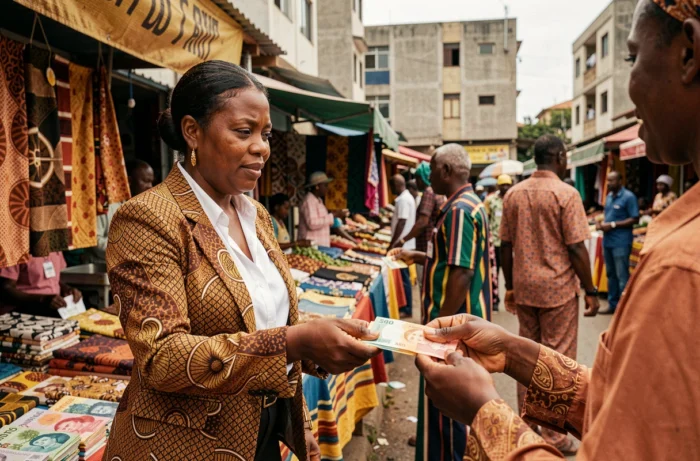
Why is this amount so rarely mentioned in international comparisons? Because the SMIG does not reflect either the practices of the informal sector or the salaries offered by large companies in Dakar. It sets a legal floor, not a typical income.
Salaries in Dakar and the Regions: Very Different Realities
The income gap between the Senegalese capital and the rest of the country is a structuring element. Dakar concentrates the headquarters of multinationals, public institutions, and international organizations. Professionals working there earn significantly higher salaries than their counterparts in rural areas.
Several factors explain this gap:
- The cost of living in Dakar is significantly higher, prompting formal employers to offer more competitive salaries to attract talent.
- Expatriates and employees of international organizations based in Dakar pull the average upwards, with compensation packages aligned with global market standards.
- In rural areas, agricultural and artisanal activities dominate, with seasonal incomes often below the SMIG.
A salary deemed adequate in Dakar does not cover the same needs as in the regions, and vice versa. A monthly budget of 150,000 FCFA in Thiès or Ziguinchor offers a different purchasing power than it does in the capital.
New Senegalese Labor Code: What Changes for Employees
The Senegalese National Assembly has adopted a new Labor Code that introduces several unprecedented provisions. Among them, a legal framework for teleworking and strengthened measures on social data protection and maternity.
This text has also integrated arbitration mechanisms for disputes related to remuneration. For both employers and employees, these changes alter the way contracts are negotiated and executed.
The impact on salaries is not yet measurable on a large scale, but the new code aims to better regulate compensation practices, including for remote workers. For the Senegalese diaspora in France or elsewhere, considering a professional return, this regulatory evolution deserves particular attention.

Framework for Comparing Salaries in Senegal
Comparing a Senegalese salary to a French or Ivorian salary without a reference framework makes little sense. Here are the criteria to consider before any comparison:
- The exchange rate between the CFA franc (FCFA) and the euro is fixed (1 euro = 655.957 FCFA), which simplifies conversions but says nothing about local purchasing power.
- The social insurance system in Senegal differs significantly from the French model: employer and employee contributions do not cover the same risks.
- The net salary received does not reflect the total cost for the employer, which includes social charges and sometimes benefits in kind (housing, transport).
- International establishments based in Dakar often apply hybrid salary scales, mixing local and international references.
A salary of 300,000 FCFA per month in the formal sector in Dakar places an employee in a revenue bracket well above the national median. This data is more telling than a simple arithmetic average skewed upwards by a few highly paid profiles.
The Senegalese job market remains marked by the coexistence of two worlds: a restricted formal sector, where scales exist and minima apply, and a vast informal sector where incomes depend on daily negotiation. Any reading of salaries in Senegal that ignores this duality remains incomplete.