
A foot-operated bin transforms a foot press into lid opening through a mechanical lever system. This principle, used for decades, relies on the transmission of a vertical movement to a rigid rod that lifts the lid without hand contact. Understanding this mechanism allows for better model selection, proper maintenance, and anticipation of common breakdowns.
Lever mechanism of a foot-operated bin: anatomy of the system
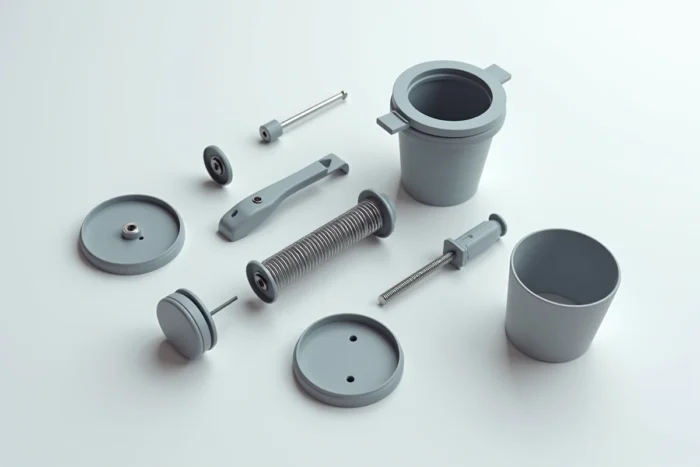
The operation relies on three articulated parts. The pedal, fixed to the base of the bin, pivots around an axis. When the foot presses down, the inner end of the pedal pushes a transmission rod (often a metal rod) upwards.
This rod is connected to the lid by a hinge or an articulated arm located at the back. The mechanical force thus follows an “L” path: the movement goes down under the foot, then rises via the rod to lift the lid. The lever ratio between the length of the pedal and the stroke of the rod determines the effort required.
On most models, a return spring brings the lid back to the closed position as soon as the pressure on the pedal ceases. This spring, housed in the hinge or along the rod, is the main wear part. When a foot-operated bin no longer closes properly, it is almost always this spring that has lost its tension.
To better visualize each step of this kinematic chain, the bin opening mechanism explained on Maisons Alternatives details the relevant parts with precision.

Differences between metal and plastic mechanisms
The material of the rod and hinges directly affects the lifespan of the opening system. The two main construction families age differently.
Metal rods and hinges
Foot-operated bins made of stainless steel generally use a bent steel rod and metal rivets at the pivot points. This type of connection withstands a large number of opening-closing cycles without deformation. The rigidity of the metal ensures a direct transmission of force, without play or unwanted flexing.
The weak point remains corrosion. In kitchens, water splashes and food residues attack the friction areas if the surface coating (chroming, epoxy paint) is scratched. Regularly wiping the joints with a dry cloth is enough to limit this risk.
Plastic rods and pivots
Plastic-bodied models often incorporate rods made of polypropylene or nylon. Plastic absorbs shocks better but deforms under repeated stress. After several months of daily use, the rod may bend slightly, reducing the useful stroke and preventing the lid from opening fully.
The advantage of plastic: no risk of corrosion and reduced weight. For an office or bathroom where the frequency of opening remains moderate, this compromise holds up.
Common breakdowns and repairs of the pedal system
Three types of malfunctions cover almost all cases encountered with a domestic or professional foot-operated bin.
- The lid no longer stays open when pressing the pedal: the rod has detached from its anchor point on the lid. Often, it is enough to reclip or re-screw the attachment.
- The lid closes too slowly or remains ajar: the return spring has lost its tension. On some models, it can be replaced without tools, simply by unhooking the rear hinge.
- The pedal squeaks or resists: the pivot points lack lubrication. A drop of mineral oil on each rotation axis eliminates friction and prolongs the flexibility of the mechanism.
Before discarding a faulty foot-operated bin, checking these three points takes less than five minutes. Most parts (rods, springs, hinges) are available as spare parts from manufacturers who incorporate a repairability approach in their design.
Foot-operated bin in professional kitchens: HACCP constraints
In collective catering, the choice of a foot-operated bin is not limited to design or price. HACCP guidelines impose specific design criteria to avoid cross-contamination during the handling of food waste.
Surfaces must be smooth, non-porous, with no corners where residues could accumulate. The lid must be easily removable for frequent cleaning with hot water. Closed or encapsulated hinges are preferred over open hinges that trap organic matter.
This hygiene requirement directly influences the mechanism: professional models favor stainless steel rods with sealed joints rather than systems with exposed springs. The additional cost is justified by the ease of disinfection and compliance with health inspections.
Eco-design and durability of foot-operated bins
Extended Producer Responsibility (EPR) schemes push manufacturers to rethink the end-of-life of their products. For a foot-operated bin, eco-design translates into several concrete choices:
- Separately recyclable materials (steel body, inner bucket made of polypropylene identified by pictogram)
- Detachable assemblies without glue, to facilitate sorting at recycling centers
- Replaceable wear parts (spring, rod, pedal) rather than a disposable product at the first breakdown
- A reduction in non-recyclable surface treatments (solvent paints replaced by powder coatings)
This approach, supported by organizations like Ecologic, aims to integrate environmental criteria from the product design stage. Consumers can identify these efforts by checking if the manufacturer offers a catalog of spare parts and a disassembly guide.
The pedal mechanism remains a naturally durable mechanical solution: no batteries, no electronic sensors, no components with planned obsolescence. When the rod and spring are replaceable, a well-maintained foot-operated bin far exceeds the lifespan of its automatic opening equivalents.