
The choice of a hedge trimmer depends on three parameters that most guides gloss over: the spacing of the teeth, the vibration frequency of the motor, and regulatory compatibility with your noise environment. Even before comparing power types, these technical criteria determine cutting quality, perceived fatigue, and legal risks related to noise.
Risk of fines and noise level: a legal criterion for choosing a hedge trimmer
A hedge trimmer is no longer just a gardening tool. Since October 1, 2023, Article R.1337-7 of the Public Health Code punishes neighborhood noise related to gardening with a 4th class fine: a fixed penalty of 135 euros, up to 750 euros in cases of nuisance characterized by its duration, repetition, or intensity.
Prefectural and municipal orders strictly regulate time slots. During the week, the typical window is between 8:30 AM and 7:30 PM. On Saturdays, it often reduces to 9 AM – 12 PM and 3 PM – 7 PM. On Sundays, some municipalities only allow the use of noisy tools between 10 AM and 12 PM.
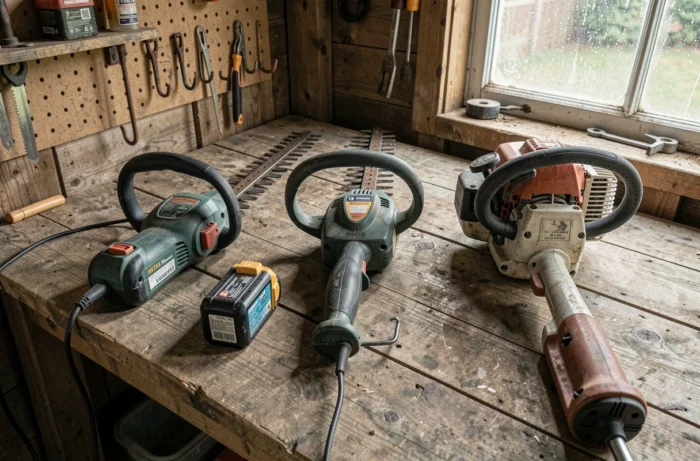
We recommend checking the applicable order for your municipality before making any purchase. A petrol model, whose noise level far exceeds that of a battery model, requires shorter trimming sessions to stay within the allowed time slots. On a long hedge, this can turn a morning’s work into a project stretched over two days. The catalog available at taille-haie-warrior.com allows for comparing motor types while considering this acoustic constraint.
Tooth spacing and cutting diameter: the specification that no one reads
The spacing between the teeth of the blade determines the maximum diameter of branches that the hedge trimmer can cleanly shear. Too tight a spacing on a mature laurel hedge causes jams. Too wide a spacing on boxwood leaves fine stems intact and produces an uneven finish.
The rule is simple: the spacing should correspond to the average diameter of the branches to be cut, not the exceptional maximum diameter. For branches that exceed the tool’s capacity, a lopper or pruning shears are more suitable than forcing the machine.
Blade length and type of hedge
A short blade offers more maneuverability for sculpted hedges or topiaries. A long blade covers more surface area with each pass on a linear fence hedge. We observe that many individuals choose a blade that is too long out of a concern for speed, then struggle to maintain a consistent cutting plane due to the inability to control the tool at arm’s length.
A blade suited to the actual width of your hedge avoids rework and unnecessary fatigue. On a narrow hedge that is regularly maintained, a medium-sized blade is more than sufficient.
Battery, corded, or petrol: deciding based on real constraints
Comparative guides systematically oppose these three power types by their generic advantages and disadvantages. In practice, the choice depends on a single dominant factor that varies with each garden.
- The distance to the nearest electrical outlet distinguishes between corded and cordless. Beyond a reasonable extension cord, corded becomes a risk of accidental cable cutting in the hedge.
- The total surface area of the hedge to be trimmed in one session determines whether a battery’s autonomy is sufficient. On long dense hedges, a petrol model remains the only one to guarantee a continuous session without interruption for recharging.
- The weight tolerable by the user during one to two hours of work with arms raised sometimes excludes petrol, which is heavier, in favor of a battery model even if the autonomy requires a break.
- The noise context (close neighbors, restrictive municipal order) can automatically eliminate petrol, regardless of the required power.
We recommend starting from the most penalizing constraint rather than the budget. A cheap petrol model that can only run for two hours a week due to time restrictions costs more in time than a more expensive battery model at purchase.
Weight, balance, and ergonomics of the hedge trimmer: what matters after thirty minutes
The weight listed on the technical sheet does not reflect actual fatigue. The distribution of mass between the motor and the blade conditions the effort required to hold it, especially when cutting vertically on the sides of the hedge. A tool whose center of gravity is too far forward pulls the wrist down and forces compensation with the shoulder.
The rotating handle, present on some models, allows switching from horizontal cutting (top of the hedge) to vertical cutting (sides) without changing body position. On a tall hedge, this feature significantly reduces strain on the lower back.
Vibrations and prolonged sessions
The vibration frequency is rarely mentioned in consumer comparisons. The vibrations transmitted to the hands and forearms generate cumulative neuromuscular fatigue. An effective anti-vibration system extends the comfortable working duration of a trimming session. Professional models incorporate shock absorbers between the motor and the handles, a technology that is gradually becoming more common in mid-range models.
Blade maintenance: the action that preserves a clean cut
A poorly maintained blade crushes branches instead of shearing them. Oxidized sap and plant residues accelerate tooth corrosion and increase friction, which puts more strain on the motor and reduces autonomy on battery models.
After each session, a cleaning with resin and lubrication of the teeth with an appropriate spray is sufficient. Regular sharpening of the teeth maintains a clean cut that promotes healing of the plants, a point often overlooked that directly impacts the health of the hedge.
The choice of the best hedge trimmer is not just a matter of power or price. Local noise regulations, tooth spacing relative to your species, the balance of the tool in hand, and the rigor of blade maintenance weigh as much, if not more, than the type of motorization.