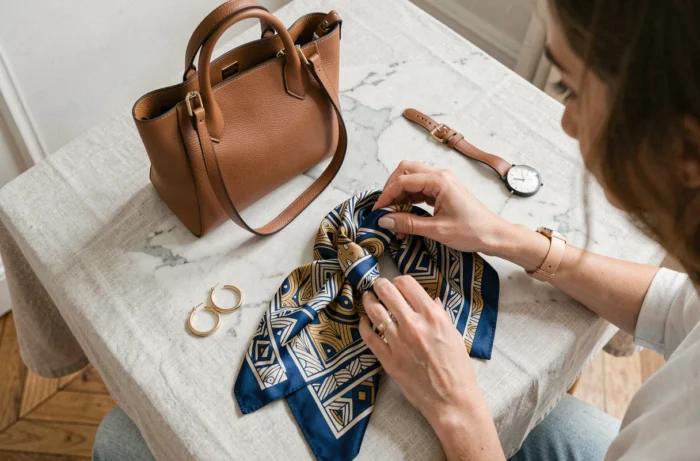
The fashion accessories market is undergoing a period of restructuring. With the rise of second-hand items, the tightening of European regulations on environmental claims, and aesthetic trends evolving each season, choosing accessories is no longer just a matter of taste. The context encourages a closer look at what we buy, why, and under what conditions these products reach us.
Directive (EU) 2024/825: What changes for fashion accessories starting September 2026
Most buying guides overlook a major regulatory turning point. The Directive (EU) 2024/825, known as “Empowering Consumers for the Green Transition,” adopted on February 28, 2024, will become fully applicable starting September 27, 2026.
In practical terms, vague mentions like “eco-friendly,” “green,” or “environmentally friendly” on bags, jewelry, belts, or glasses without tangible proof will become practices automatically considered unfair. Brands that persist risk fines of at least 4% of their turnover for large-scale violations.
For consumers, the direct consequence is simple: labels will have to justify themselves. A trendy accessory collection claiming a responsible approach will need to rely on recognized certification or demonstrable environmental performance. The marketing blur surrounding “green” accessories is coming to an end.

Second-hand and accessories: a price reflex reshaping the market
Accessories (bags, jewelry, belts, scarves) are among the most purchased categories in second-hand. The motivation is twofold: price, first, but also a growing environmental concern. Specialized resale platforms capture a significant share of demand, particularly for high perceived value items like leather bags or designer jewelry.
This dynamic raises a question for brands selling new items. How to justify the price of an accessory when a second-hand equivalent circulates for a fraction of the amount? Field returns vary on this point: some brands see it as a threat, others as a visibility lever, since resale keeps their products in the conversation.
What second-hand does not cover
Sunglasses, technical belts, and personalized accessories remain difficult to find second-hand in satisfactory condition. The wear of these pieces limits their lifespan in the resale market. It is in these segments that new purchases retain their advantage, provided that the quality of manufacturing is up to par.
Autumn-Winter 2026 accessory trends: pieces that structure a look
Rather than an endless list of “must-haves,” let’s focus on the categories that truly alter the perception of an outfit this season.
- Massive metal jewelry (thick chains, sculptural rings) dominates the runways and street style. The choice of material matters: stainless steel resists oxidation, making it a compromise between durability and budget
- Small or structured bags replace the oversized models of previous seasons. A rigid bag with a short strap is enough to anchor a style, even on a minimalist outfit
- Thick or colorful framed sunglasses function as a standalone accessory, not just as protection. Their visual impact on a look is disproportionate to their cost
A single well-chosen accessory transforms an outfit more than three mismatched pieces. Accumulation remains a common trap. It is better to invest in a strong piece (a structured bag, a readable watch, a distinctive pair of glasses) than to spread one’s budget thin.

Belts and scarves: the underestimated accessories
The belt returns as a structuring element of the look, not just functional. Worn over a flowing dress or an oversized coat, it alters the silhouette. Wide models in leather or woven fabric are the most versatile.
The scarf, for its part, remains the most adaptable accessory: as a neck wrap, headband, or tied on a bag. Its ability to effortlessly change the identity of an outfit makes it a worthwhile investment.
ESPR Regulation and eco-design: what will weigh on textile accessories
Beyond the directive on green claims, the Regulation (EU) 2024/1781 on the eco-design of sustainable products (ESPR) extends eco-design requirements to nearly all physical goods, accessories included. This means that bags, scarves, and other textile pieces will gradually have to meet criteria for sustainability, reparability, and traceability.
The available data does not yet allow for conclusions on the exact implementation timeline by product category. However, the direction is clear: accessories sold in the EU will need to display verifiable information about their lifecycle. Brands that anticipate this requirement will have a competitive advantage, while others will have to adapt urgently.
For buyers, this regulatory framework offers a concrete filter. Before splurging on an accessory labeled “sustainable,” checking for the existence of third-party certification (GOTS, OEKO-TEX, Bluesign) remains the most reliable reflex. The absence of a recognized label on a product claiming to be ecological should now raise alarms rather than provide reassurance.
Choosing an accessory in 2026 is not just about following a trend. European regulation is reshuffling the cards among brands, and the rise of second-hand is changing shopping habits. Choosing a piece that lasts, whose claims are verifiable, and that truly integrates into one’s wardrobe: this is the only approach that holds in the long term.