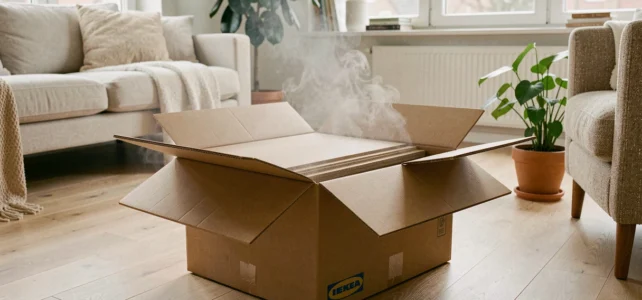
Ikea furniture made from particle board or MDF emits volatile organic compounds (VOCs) right out of the box. These substances come from the resins, glues, and finishes used during manufacturing. Their concentration in indoor air depends on the size of the furniture, the room’s ventilation, and the ambient temperature. Understanding the nature of these emissions helps define an appropriate airing duration.
The question of how long to air out an Ikea piece of furniture often arises after assembling a BILLY bookshelf or a PAX wardrobe. The answer varies depending on several technical parameters that need to be examined one by one.
Formaldehyde and VOCs: what an Ikea particle board emits
Formaldehyde is the main VOC emitted by engineered wood panels. It is part of the composition of urea-formaldehyde resins that bond the fibers or particles together. At room temperature, these resins slowly release gaseous formaldehyde, which is responsible for the characteristic smell of new furniture.
Melamine or laminated finishes add an extra layer of emissions. A piece of furniture with several uncoated surfaces (back, drawer bottom, inside of the case) emits more than a piece that is fully covered.
The peak emission occurs in the first hours after unpacking, then gradually decreases. This decrease is not linear: most VOCs are released during the first few days, but residual emissions persist at low concentrations for several weeks.
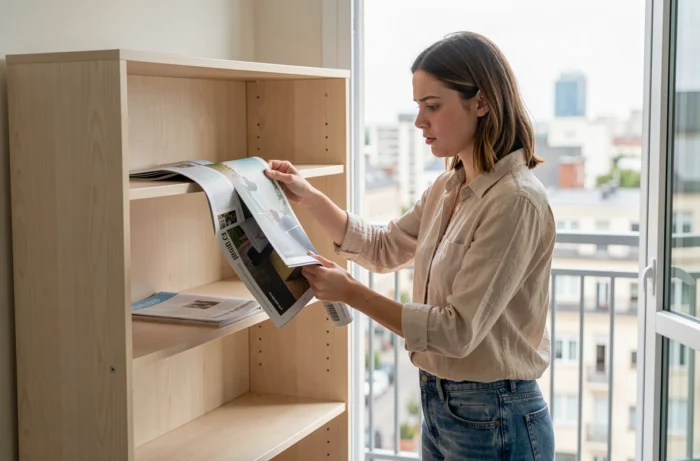
Airing duration for an Ikea piece of furniture: concrete guidelines based on situations
No universal duration applies to all furniture. Three factors determine the necessary time: the type of panel, the exposed surface area, and the ventilation conditions.
Standard particle board and MDF
A classic particle board piece of furniture (KALLAX, MALM, BILLY) requires at least 48 to 72 hours of airing with open windows for the noticeable odor to significantly decrease. For sensitive individuals or in a bedroom, extending this period to a full week significantly reduces exposure.
Large furniture or closed compartments
Wardrobes with doors and drawers concentrate VOCs in enclosed spaces. Keeping all doors, drawers, and cases open during airing is a prerequisite. Without this, the interior surfaces continue to emit without the airflow reaching them. A PAX piece with six closed drawers will take much longer to lose its smell than an open shelf.
Influence of heat and humidity
Heat accelerates the off-gassing of VOCs. A piece of furniture aired in a moderately heated room (around 20-22 °C) emits faster than one stored in a cold garage. The counterintuitive trick is to maintain a slightly elevated temperature while actively ventilating: the heat forces the emission, and the airflow carries away the gases.
In winter, with closed windows and heating turned up, vapors stagnate. The furniture seems to lose its smell more slowly because the VOCs remain trapped in the room.
European regulation on formaldehyde: what changes in 2026
Regulation (EU) 2023/1464 modifies Annex XVII of REACH and becomes applicable on August 6, 2026, for wood-based furniture and panels. It sets a formaldehyde emission limit of 0.062 mg/m³, which is about half of the ceiling associated with the old E1 class (0.124 mg/m³).
Any Ikea furniture placed on the European market from this date must comply with this threshold. In practice, this means that the panels used will emit less formaldehyde right out of the factory. The peak odor upon unpacking should therefore be less pronounced on furniture manufactured according to this new standard.
This change does not eliminate the need to air out, but it reduces the intensity and duration of bothersome emissions. For a piece of furniture purchased after August 2026, 48 hours of airing in a ventilated room should be sufficient in most cases.
Methods to accelerate the elimination of odors from new furniture
Airing remains the most effective action, but a few complementary techniques can shorten the off-gassing period.
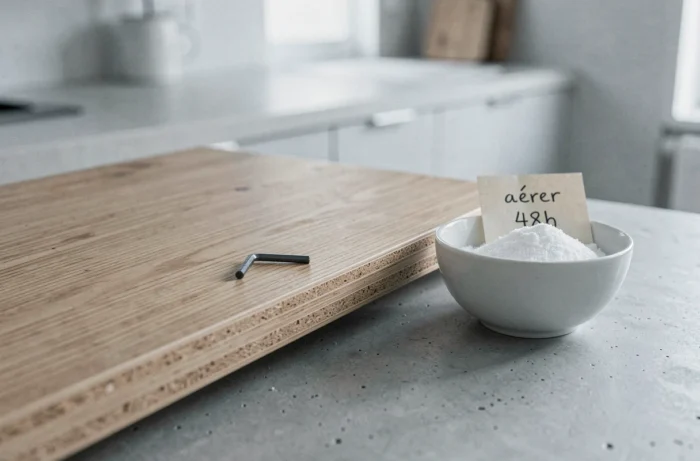
- Place bowls of baking soda inside closed compartments: baking soda absorbs some of the odor-causing molecules without masking the problem with a fragrance
- Wipe all interior surfaces with a damp cloth before first use, capturing dust particles laden with VOCs that settled during storage
- Place activated charcoal sachets in drawers and shelves: this porous material traps volatile compounds through adsorption, with greater effectiveness than baking soda on formaldehyde
- If assembly takes place in an apartment, create a cross draft by opening two opposite windows rather than just one ajar
These methods do not replace airing time. They accompany it. A piece of furniture treated with activated charcoal and actively ventilated loses its smell faster than one simply left in a closed room with the window slightly open.
Signs that off-gassing is complete
The absence of a noticeable odor does not guarantee the total end of emissions. VOCs can be present at concentrations too low to be detected by the human nose while remaining measurable by a sensor.
Two practical indicators help assess the situation:
- Close the furniture (doors, drawers) for several hours and then open it: if no odor is released, most of the off-gassing is complete
- Place an untreated clean cloth inside a closed drawer for 24 hours: if the cloth retains no odor, the furniture can be used normally
- Observe the reaction of people outside the household, whose noses are not accustomed to the residual odor
A piece of furniture that still causes headaches or respiratory irritation requires prolonged airing, regardless of how much time has already passed. Individual sensitivity varies, and children or asthmatic individuals react to lower thresholds.
For a standard Ikea particle board piece of furniture, plan for at least three days with windows open, compartments open, and regular airflow. After the new REACH regulation comes into effect in August 2026, this duration could be reduced to two days under proper ventilation conditions. Activated charcoal and baking soda remain useful supplements, not substitutes for thorough airing.