
When selling an apartment or a house, the first concrete step is the valuation. We often compare the price displayed by an online tool with that announced by the local agent, without always measuring what separates the two. Omnia Immobilier, like other platforms, offers an algorithmic valuation intended to compete with the work of a local agency. The promise is appealing, but reliability depends on parameters that most sellers underestimate.
Gap Between Algorithmic Valuation and Actual Selling Price
For a standard T3 in a large metropolis, online valuation tools rely on transaction databases (notably the DVF data published on data.gouv.fr). The volume of comparable sales is sufficient for the algorithm to produce a coherent result.
The situation changes radically as soon as we move away from standardized properties. A comparison published by Valoriz Expertise in September 2026 shows that PAP displays an average gap of 7.6% compared to the final selling price, while SeLoger reaches 8.5%, with underestimations exceeding 16% on certain houses. Efficity and Bien’ici show even more marked gaps, at 13.4% and 17.5% respectively, with net overestimations on certain apartments.
These figures concern competing platforms, but they illustrate a structural problem: AVM models struggle with atypical properties or low-density markets. The feedback compiled on the reviews of Omnia Immobilier confirms that accuracy varies greatly depending on location and property type.
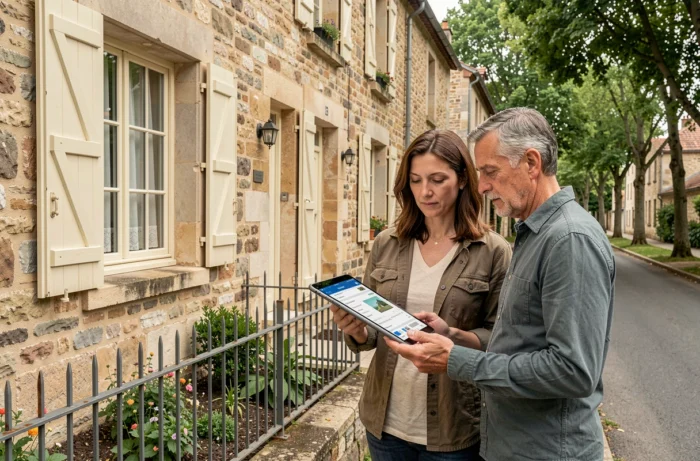
Online Property Valuation: What the Algorithm Doesn’t See
An AVM (Automated Valuation Model) processes quantitative data: area, number of rooms, floor, postal code, transaction history. It is effective for rough estimates but insufficient for conclusions.
Here’s what no algorithm captures from a distance:
- The actual condition of the property: an original floor in good condition or a newly renovated kitchen can represent several thousand euros in difference, invisible in the DVF data
- The micro-location: two parallel streets in the same neighborhood do not have the same value if one faces a noisy thoroughfare and the other overlooks a square
- The co-ownership and its charges: a façade renovation voted but not yet called, ongoing procedures, a failing property manager, all of this impacts the price without appearing in public databases
- The recent local dynamics: a new tram line, a school project, the closure of a key business. The local agent knows this; the algorithm ignores it until transactions incorporate it, with several months of delay
A report published by Dynseo in August 2026 confirms this gap: in rural areas or with atypical properties, the gap between automatic estimation and reality can exceed 20%. In very dense markets, the margin of error is significantly reduced.
Local Agency and Online Valuation: Complementarity Rather Than Competition
It would be a mistake to choose one over the other. Online valuation provides a quick, free estimate accessible at any time. It helps filter out agents who might propose an unrealistic price to secure a mandate.
The local agency then corrects the valuation during the visit, incorporating qualitative elements. A broker who has known the area for several years identifies details in minutes that the algorithm will take months to capture through future transactions.
The most reliable sequence for a seller remains as follows:
- Start an online valuation on two or three different platforms to obtain a range
- Request two independent local agencies for a visit and a reasoned value opinion
- Compare the results: if the gap between the two approaches exceeds 10%, explore the reasons with the agent before setting the selling price
Feedback varies on this point, but many sellers find that cross-referencing three sources significantly reduces the risk of overestimation, which remains the primary cause of properties stagnating on the market.
The Trap of Online Overestimation
Some platforms have a structural bias towards overestimation. Displaying a flattering price encourages the owner to sign up, leave their contact details, and enter a lead generation tunnel. The platform’s business model relies on the volume of contacts passed to partner agencies, not on the accuracy of the valuation.
Omny, for example, raised 750,000 euros in pre-seed funding and aims for qualified connections between buyers and agencies. The revenue comes from leads, not from the accuracy of the displayed price. This logic does not disqualify the tool, but it requires understanding what one is consulting: a starting point, not a selling price.

Valuation Strategy: Adapting the Method to the Type of Property
For a recent apartment in a standardized residence in a medium-sized city, algorithmic valuation often suffices to frame the price. Comparable data is abundant, and discrepancies are limited.
For a character home, a property with a garden in the city center, a mixed-use space, or a rental building, the intervention of a local professional remains the only reliable method. No database reflects the rarity of a property, and it is precisely this rarity that drives the price in these segments.
For very active markets like Geneva or major French metropolises, platforms have enough recent transactions to produce usable valuations. However, in areas where sales are spaced out, the algorithm extrapolates from data that is too old or too geographically distant.
The choice between online valuation and a local agency is not a matter of principle. It is a matter of property, market, and the volume of available data. A seller who understands this saves time and, above all, avoids starting with a price that will scare off buyers in the first few weeks.