
A pregnant woman who catches a sore throat in the middle of winter quickly finds herself at a loss: most conventional medications are not recommended, and mouth sprays containing propolis seem like a gentle alternative. You open the bottle, hesitate, and put it back down. Propolis contains hundreds of active molecules, including polyphenols and flavonoids, and its pharmacological profile is not trivial during pregnancy.
Adverse effects of propolis reported by ANSES: what mouth sprays reveal
The ANSES nutrivigilance system has compiled reports of adverse effects related to products containing propolis between 2009 and 2024. The finding: an increase in hypersensitivity reactions, including contact dermatitis, the frequency of which has been rising since the 1970s.
Among these reports, a notable proportion is classified as severe. Several cases have endangered lives, and at least one death has been documented. These figures do not concern only fragile individuals or those with known allergies.
A significant portion of adverse effects occurs after the use of mouth sprays. This is precisely the form that many pregnant women consider in case of sore throats or winter ENT infections. The highly vascularized oral mucosa absorbs active compounds quickly, which can amplify the allergic response.
To understand the issues related to propolis in pregnant women, one must integrate this recent health signal, often absent from commercial sheets.

Propolis and cross-allergy to hive products during pregnancy
If you are allergic to pollen, honey, or bee stings, propolis poses an increased risk. Pregnancy alters immune reactivity: the maternal immune system adapts to tolerate the fetus, which can make allergic reactions less predictable than normal.
Feedback varies on this point, but it is observed that some women develop new sensitivities during pregnancy, including to substances they previously tolerated. Propolis, which contains complex plant resins, can trigger contact dermatitis even with topical application.
Warning signs to watch for
- Redness, itching, or swelling in the mouth or skin after applying a product containing propolis, even in small doses
- Breathing difficulties or a feeling of chest tightness, even mild, which require immediate cessation and a call to the doctor
- History of eczema or asthma, which significantly increases the risk of hypersensitivity reactions to hive products
Any first use of propolis during pregnancy should be validated by a healthcare professional, especially if it has never been consumed before.
Oral route, topical route: precautions differ depending on the form of propolis
The risks are not the same with a capsule, a spray, or a balm. By oral route (tincture, capsules, sprays), propolis enters the bloodstream and potentially reaches the fetus. Clinical data on the safety of ingested propolis during pregnancy remain insufficient to conclude its safety.
By topical route, the situation is different. No formal contraindication is established for the local application of balms or creams containing propolis on healthy skin, provided one is not allergic. It can, for example, be used on small cracks or skin irritations, testing first on a limited area.
Duration and dosage: keep it light
For a mouth spray, the common recommendation is to not exceed five consecutive days of use. Beyond that, the risk of sensitization increases. It is also advisable to avoid combining multiple hive products (honey enriched with propolis + spray + capsules): the total dose of active compounds then becomes difficult to control.
The mother tincture of propolis, often offered in herbal shops, poses an additional problem: it contains alcohol. The concentration varies by manufacturer, but any alcoholic form is not recommended during pregnancy, even in small amounts.
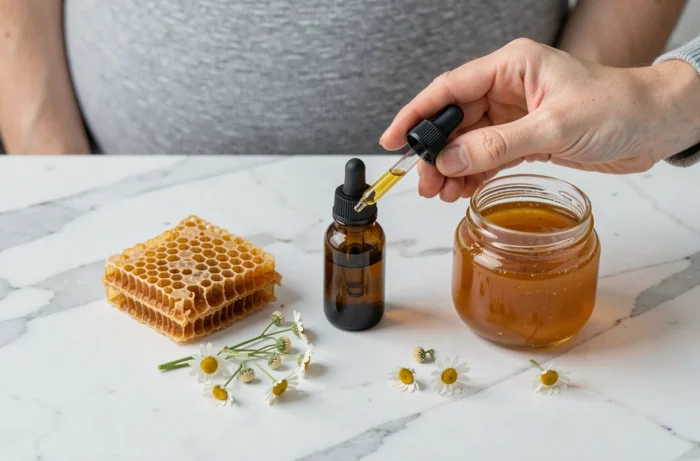
Organic propolis and product quality: concrete selection criteria
Not all products labeled “propolis” are equal. The composition varies significantly depending on geographic origin, the tree essences foraged by bees, and the extraction processes used by the manufacturer.
- Prefer a certified organic product, which limits exposure to pesticides, a particularly sensitive point during pregnancy
- Check the list of excipients: some sprays contain preservatives or synthetic fragrances that are best avoided during pregnancy
- Choose a manufacturer that clearly states the origin of its propolis and its extraction method (aqueous extraction rather than alcoholic for pregnancy)
- Avoid multi-composed products that combine propolis, royal jelly, and pollen, as they multiply potential sources of allergic reactions
A quality product displays complete traceability. If the label remains vague about the origin or concentration of propolis, it’s best to pass.
Propolis and potential benefits: what research explores without yet confirming
The antimicrobial, antioxidant, and immunomodulatory properties of propolis are documented in vitro. Research is exploring its potential role in glycemic balance and gut health, two relevant topics during pregnancy where gestational diabetes and digestive disorders are common.
We remain on research tracks, not on solid clinical evidence. No large-scale study has validated a specific benefit of propolis in pregnant women. Promising results mainly come from animal models or in vitro studies, which do not allow direct transposition to human pregnancy.
Propolis does not replace medical follow-up or a balanced diet. If its properties are ever confirmed by rigorous clinical trials, it could complement the prevention arsenal, but we are not there yet. In the meantime, caution remains the only reasonable stance, and the safest reflex is to consult your doctor or midwife before any intake.