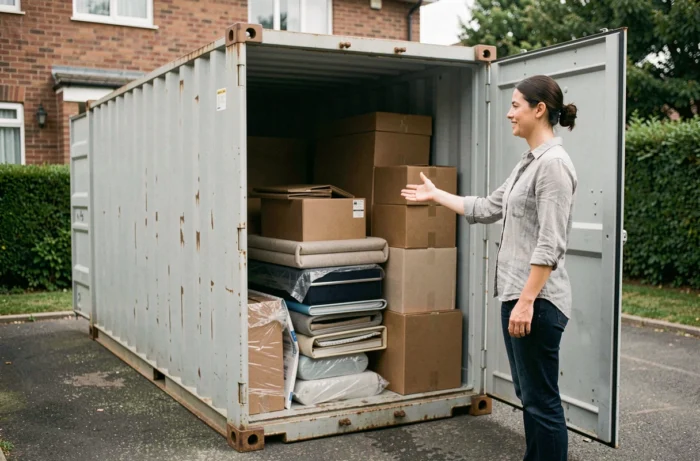
Three cubic meters is a volume that most people handle without ever visualizing it. It appears on moving quotes, technical sheets for rental vans, and storage unit pricing grids. The problem remains the same: translated into everyday objects, this figure doesn’t say much until it’s confronted with real dimensions.
The trap of irregular shapes when filling 3 m3
A perfect cube of 3 m3 would measure about 1.44 m on each side. No one stores their belongings in a perfect cube. Furniture has armrests, legs, and angles that create air pockets that are impossible to fill.
This is why moving professionals systematically apply a margin between the theoretical volume of objects and the usable volume of the vehicle or box. The actual volume occupied often exceeds the calculated cubic volume item by item, sometimes significantly, due to these lost spaces between irregular shapes.
To understand what a volume of 3 m3 corresponds to, one must think in terms of realistic stacking rather than adding up unit volumes. A three-seater sofa, for example, does not compress: its apparent volume includes all the space under the cushions and between the armrests.
Cardboard boxes, on the other hand, stack neatly. A standard moving box (approximately 60 x 40 x 40 cm) occupies about 0.1 m3. In theory, thirty boxes fill 3 m3. In practice, the height available in a van or box often limits stacking to four or five levels before stability becomes an issue.
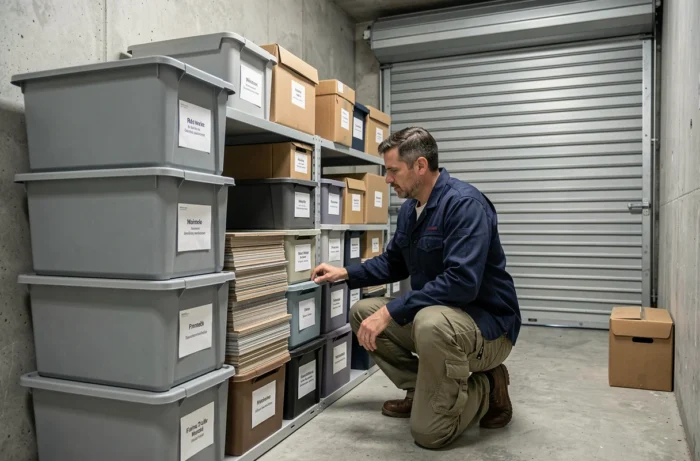
Concrete examples of objects in a volume of 3 cubic meters
Rather than an exhaustive list, let’s focus on three realistic combinations that help grasp the scale.
Living room combination
A two-seater sofa, a coffee table, a medium-sized TV stand, and a few boxes of dishes reach about 3 m3. The sofa alone takes up nearly half of the available volume. Living room furniture is the most space-consuming in cubic meters relative to its weight.
Bedroom and office combination
A disassembled single bed (frame, mattress rolled or folded), a four-drawer dresser, an office chair, and about ten boxes of books fill the space. Books are heavy but occupy a predictable volume, making them a good filler between furniture.
Appliance and bulk combination
A standard refrigerator, a washing machine, and a few boxes of small appliances (toaster, coffee maker, vacuum cleaner) quickly saturate the 3 m3. Two large appliances are enough to occupy more than half of the volume. The rest is played out in the gaps.
Storage in a box: what 3 m3 implies in height and floor space
Self-storage operators offer boxes with varying floor areas, but the height generally exceeds two meters. A 3 m3 box can therefore take the form of a space of about 1.5 m2 on the floor and two meters in height, or a slightly different configuration depending on the provider.
This distinction matters. A narrow but tall box forces stacking, which excludes fragile items from the bottom of the pile. A wider but shallower box makes access easier but wastes volume in height if the furniture is low.
- Heavy boxes (books, dishes) should be placed at the bottom to stabilize the whole and never crush lighter items.
- Vacuum bags significantly reduce the volume of duvets, pillows, and winter clothes, freeing up space for rigid shapes.
- Systematically disassembling furniture (table legs, shelves, bed frames) transforms bulky volumes into stackable flat packages.
A often overlooked point: regulations govern what can be stored in a box. Flammable liquids, compressed gases, chemicals, toxic or corrosive products are explicitly prohibited. The decree of July 27, 2026, further specified the conditions for converting certain parking spaces into storage areas, with a maximum area of 26 m2 per box and a limit of 10% of convertible spaces in parking lots with fewer than 100 spots.
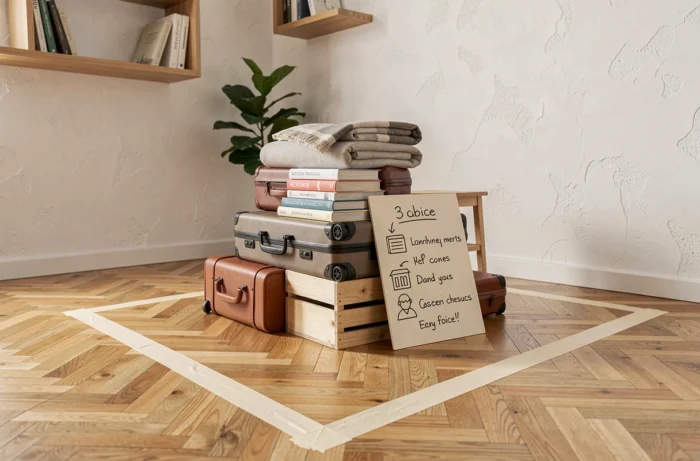
Storage tips to make the most of every cubic meter
Optimizing a volume of 3 m3 relies less on spectacular techniques than on a discipline of filling.
The first rule is to fill the empty spaces inside furniture. The drawers of a dresser, the inside of a washing machine, the space under a desk: each of these voids can hold laundry, cables, or small hardware. Professional movers prioritize exploiting these cavities.
The second concerns the loading order. Place the heaviest and bulkiest items against the back wall (or bottom) first, then gradually fill towards the front. Fragile items come last, secured by blankets or clothes that serve a dual role of protection and filling.
- Wrapping cables and securing them with rubber bands prevents them from creating dead volume in the boxes.
- Using clothing bags as cushioning material between two pieces of furniture replaces bubble wrap and saves a box.
- Photographing the load before closing the box or vehicle allows you to find an item without emptying everything.
Field reports vary on the usefulness of volume calculation apps. Some overestimate the volume by taking the overall dimensions of each piece of furniture without considering possible nesting. Others underestimate by ignoring protections (blankets, cushioning boxes) that add real volume. Measuring the three or four largest pieces of furniture yourself remains the most reliable method for anticipating the filling of a 3 m3 space.
Three cubic meters is ultimately equivalent to a large wardrobe or the contents of a small, well-organized room. The volume seems modest on paper, but when properly utilized, it can accommodate the furniture of a studio or the seasonal stock of a household without wasting space.