
A delicious everyday recipe is based on a simple principle: a dish that can be prepared without stress, that tolerates variations in ingredients, and that appeals to a diverse table. The difficulty is not technical. It lies in the ability to choose recipes whose structure remains stable even when the content changes, allowing you to cook for family or friends without starting from scratch every evening.
Modular dishes: the foundation of an everyday anti-waste kitchen
A modular dish works by assembling components rather than following a linear execution of a fixed recipe. The principle: prepare a base (grain, legume, pasta, rice) and several independent toppings, then let each guest compose their plate.
This logic addresses three recurring problems. Divergent tastes around the table, managing leftovers, and the stress of having to produce a unique dish that satisfies everyone.
Specifically, a vegetable gratin becomes modular if the vegetables are cooked separately from the béchamel. Those who don’t like zucchini can take leeks. Those who want cheese can add it. The main dish remains the same, but each portion differs. You can find ideas and recipes of this type, designed for real life, on gourmandises-et-bavardages.com with approaches focused on simplicity and conviviality.
- Savory tarts with a common base (homemade shortcrust pastry, egg-cream mixture) adapted according to seasonal vegetables: leeks in winter, tomatoes and basil in summer, mushrooms in autumn
- Cereal bowls (rice, bulgur, quinoa) with self-service toppings: roasted vegetables, grated cheese, seeds, yogurt sauce or vinaigrette
- Pasta cooked in large quantities, divided between a tomato sauce version for children and a sautéed vegetables-parmesan version for adults
The time-saving comes from the fact that the base is prepared all at once, often in advance. The toppings use what’s left in the refrigerator.
Batch cooking adapted for family and friends meals
Batch cooking involves grouping preparations within a single time slot, often on Sundays, to cover several meals throughout the week. Recent editorial trends show that this method also applies to meals with friends, not just weekday dinners.
The difference from simple “cooking ahead” lies in planning components rather than finished dishes. You don’t prepare five distinct recipes. You prepare five reusable bases.
Three versatile bases to prepare in advance
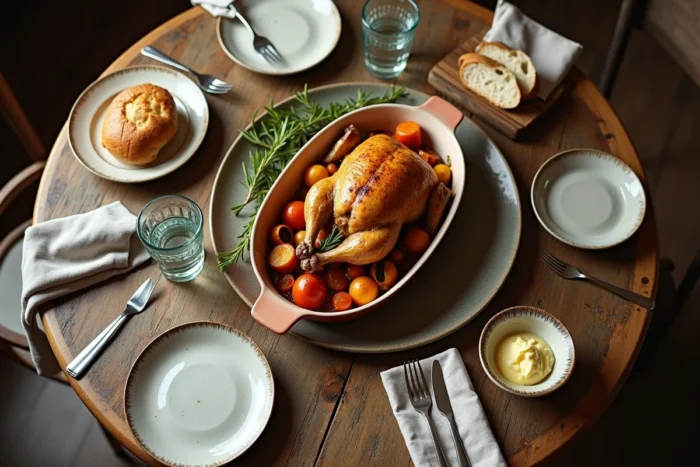
A large quantity of roasted vegetables (potatoes, carrots, squash) serves as a side on Tuesday evening as well as a salad topping on Saturday lunchtime when friends come over. A homemade broth made from vegetable scraps becomes an express soup during the week or a risotto on the weekend.
A good batch cooking doesn’t lock in menus; it provides building blocks. The flexibility comes from the fact that each component fits into multiple contexts. Cooked lentils become a cold salad, a quick dhal, or a side dish for a main course.
For large gatherings, this approach is a game changer: instead of spending three hours in the kitchen on the day itself, most of the work is already done. On the day of the meal with friends, only assembly and final cooking remain.
Seasonal recipes: adapting your dishes without multiplying shopping trips
Cooking seasonally is not just a slogan. It’s a technical constraint that simplifies choices. When you limit yourself to the vegetables available at the market, the number of options decreases, and paradoxically, decisions become easier.
In summer, a composed salad with fresh tomatoes, goat cheese, and basil requires neither a recipe nor special technique. In winter, a potato gratin with reblochon cheese meets the same need for a comforting meal without excessive effort.
The common trap is to seek complex recipes when seasonal produce is sufficient on its own. A fresh zucchini simply sautéed with garlic and a drizzle of olive oil has more flavor than an elaborate stuffed zucchini made with an out-of-season vegetable.
Adjusting quantities for a variable table
Seasonal dishes based on vegetables and starches are well-suited for large gatherings because their unit cost remains low. Adding two guests to a vegetable pasta meal means cooking an extra handful of pasta. Adding two guests to a fish fillet meal requires a second trip to the fishmonger.
This economic logic explains why the most convivial recipes, those that work just as well for four as for ten, almost always rely on plant-based or starchy foundations: homemade gratin, quiche, tart, risotto, vegetable curry.
Cooking tips for a delicious meal without an “Instagram” recipe
The highly photographed recipes on social media share a common flaw: they often require specific ingredients, long preparation times, and a visual result that doesn’t tolerate approximation. In contrast, a successful everyday meal tolerates improvisation and substitutions.
Some technical principles make the difference between a bland dish and a tasty one, without adding complexity.
- Salt the water for pasta, rice, and vegetables sufficiently: most “tasteless” dishes suffer from overly timid seasoning during cooking, not on the plate
- Always deglaze the cooking base after searing meat or vegetables: a bit of water, wine, or broth recovers the caramelized juices and creates an instant sauce
- Add an acidic element at the end of preparation (lemon juice, vinegar, tomato) to enhance a dish that seems flat, rather than adding salt or fat
- Finish with a contrasting texture element (seeds, croutons, fresh herbs, grated cheese) that transforms a simple dish into a visually and tastefully complete one
These gestures take a few seconds and are not included in any ingredient list. They fall under basic technique, not recipe. A plain vegetable gratin becomes a standout dish if the top is browned with cheese at the right temperature and if seasoning has been done at every stage.
Everyday gourmet cooking does not rely on spectacular recipes. It is based on repeated gestures, adaptable dishes, and seasonal products treated simply. The meal that works every time is one that you can recreate from memory, without opening a book or searching for a video.