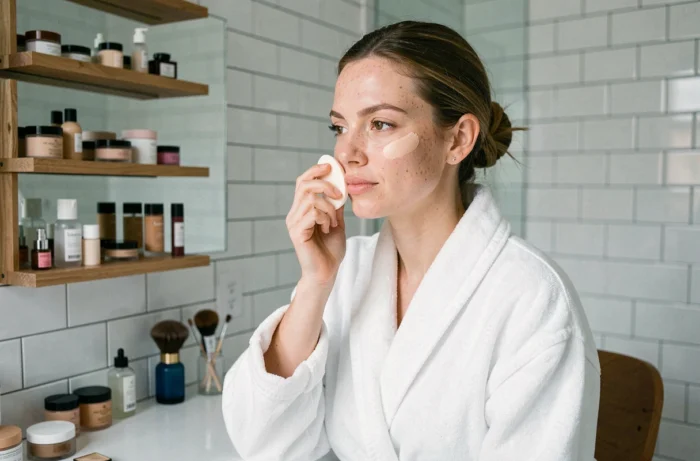
A full-coverage foundation for fair skin is not just a dense pigment applied to the face. Its formulation relies on a balance between pigment concentration, skincare base, and compatibility with low-melanin complexions, which are often more reactive to texture or shade missteps. Choosing a light and full-coverage foundation requires understanding a few technical mechanisms before heading to the store.
Undertone and fair skin: why shade alone is not enough
The majority of guides recommend testing foundation on the jawline. On fair skin, this method quickly shows its limits: the gap between the actual undertone and that of the product is more noticeable than on medium or dark complexions.
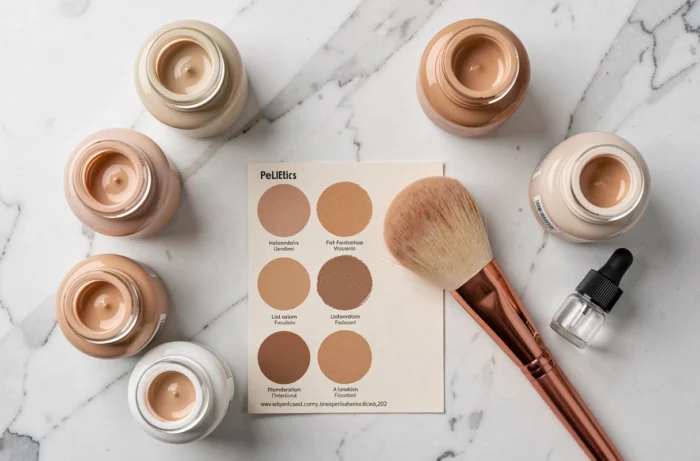
Undertones are classified into three categories: warm (yellow, golden, peach), cool (pink, red, bluish), and neutral (a mix of both). On very fair skin, a poorly identified undertone creates a mask-like effect that is visible even in natural light. A foundation labeled “porcelain” with a warm undertone applied to a cool skin tone leans orange, even if the lightness matches.
To identify your undertone, observing the veins on your wrist remains a reliable method: bluish or purple veins for a cool undertone, greenish for a warm undertone, and a mix of both for a neutral undertone. Comparing a light and full-coverage foundation to the skin on your neck (and not the back of your hand) also limits mistakes.
Coverage and formulation: what textures conceal
The coverage of a foundation directly depends on its pigment concentration. So-called “full coverage” formulas contain a high proportion of iron oxides and titanium dioxide, sometimes combined with film-forming polymers that set everything on the skin.
On fair skin, maximum coverage is not always synonymous with a natural result. A highly pigmented product applied in a thick layer flattens the skin’s texture and eliminates the translucency typical of pale complexions. The technique known as “layering” (applying thin layers) allows for modulation of coverage without saturating the skin.
Fluid, cream, or compact texture
Fluid foundations generally offer adjustable coverage. Cream textures concentrate more pigments per milliliter and are better suited for pronounced imperfections (diffuse redness, acne scars). Compacts, made from pressed powder, cover effectively but can dry out already dry skin.
- Fluid: light to medium coverage, natural finish, suitable for normal to combination skin
- Cream: medium to high coverage, satin finish, suitable for dry skin or localized imperfections
- Compact: high coverage, matte finish, suitable for oily skin but to be avoided on dehydrated skin
The choice of texture determines both the finish and the level of coverage displayed on the packaging. A well-formulated fluid, applied in two thin layers, can rival a compact in terms of camouflage.
Full-coverage foundation and skincare: hybrid formulas to know
Recent launches show a clear trend: full-coverage foundations now incorporate a high proportion of skincare base. Hyaluronic acid, glycerin, zinc gluconate, soothing plant extracts – these active ingredients are no longer reserved for lightweight BB creams.
Chanel Les Beiges, for example, combines long-lasting hydration with covering pigments in a formula that claims a “natural glow” finish. Clarins Skin Illusion Full Coverage relies on plant-based actives to maintain skin comfort despite high coverage. Vichy Dermablend, positioned in the dermatological segment, combines correction of imperfections with a non-comedogenic formula tested on sensitive skin.
This convergence between makeup and skincare addresses a concrete problem: a full-coverage foundation that dries out the skin accentuates fine lines and flakiness, especially on fair complexions where every texture flaw captures light.
Labels to check on the packaging
- Non-comedogenic: the product does not clog pores, a point to systematically check for acne-prone skin
- Dermatologically tested: indicates a tolerance protocol, not an absolute guarantee but a useful filter
- Hypoallergenic: formula designed to minimize the risk of allergic reactions, relevant for fair skin which is often more reactive
- Integrated SPF: sun protection in foundation does not replace a dedicated sunscreen, but is a valuable complement
Application on fair skin: prepare to avoid a plaster effect
No full-coverage foundation will yield satisfactory results on poorly prepared skin. Prior cleansing and hydration directly condition the grip and longevity of the product.
On fair skin, applying a smoothing primer before foundation reduces the appearance of pores and evens out the surface. The primer fills in micro-reliefs where the pigment tends to accumulate, creating those visible demarcations in side lighting.
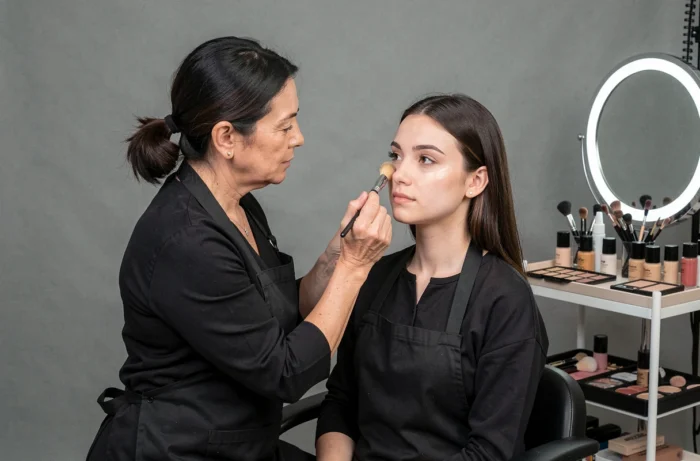
The application tool radically changes the finish. A flat brush deposits more product and is suitable for areas requiring targeted coverage (sides of the nose, lip contour). A damp sponge blends the product and gives a more seamless finish, closer to the skin. Fingers, thanks to body heat, help the product penetrate but offer less precision.
Setting the result with a translucent loose powder extends wear without adding a layer of color. On fair skin, a tinted powder that is too dark, even slightly, immediately breaks the coherence of the complexion.
Ultimately, the choice of a light and full-coverage foundation relies on three interrelated parameters: the correctly identified undertone, the texture suited to the skin type, and the formulation that respects the skin barrier. Hybrid skincare-makeup formulas, now available from most brands, make this compromise more accessible than a few years ago.