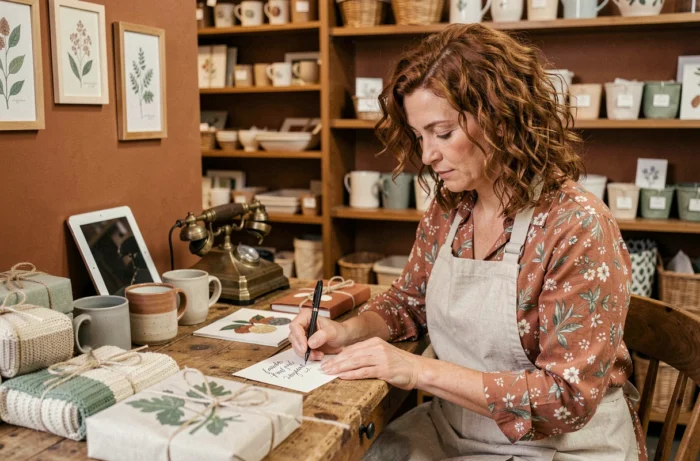
When looking to customize an item for a birthday, a birth gift, or a professional event, the first challenge arises even before choosing the product: finding the right channel to contact the person who makes it. Creative shops specializing in handmade items do not operate like a traditional e-commerce site. Their contact methods, response times, and production constraints shape the entire ordering process.
Contact form or social messaging: what works depending on the type of request
A customization request is not handled like a question about delivery times. In practice, it is observed that creators direct each channel towards a specific use.
The integrated form on the website remains the most reliable means for a custom creation request. It allows for detailing dimensions, desired materials, colors, and attaching a reference photo. Most artisanal shops display this form on a dedicated page, accessible from the main menu.
Social messaging (Instagram, Facebook) is more suited for a quick initial exchange: checking product availability, asking for an indicative price, or ensuring that the shop accepts the desired type of customization. To go further in the process, one can for example visit the Le Terrier De Lily website and access the form intended for detailed requests directly.
Direct email, when provided, is suitable for lengthy exchanges with multiple attachments (mock-ups, company logos, vector files for engraving). Responses vary on this point: some creators respond faster via their social messaging, while others exclusively prefer email to maintain a structured record.

Preparing to contact a handmade shop: the elements to provide
Sending a vague message like “I would like a personalized gift” prolongs exchanges by several days. Creators who work alone or in very small teams do not have dedicated customer service. A precise message from the first contact speeds up the quote by at least one step.
Here’s what you gain by including from the first message:
- The type of product sought (jewelry, textile accessory, decorative item, stationery) and the intended use (gift, event, personal use).
- The customization constraints: text to engrave or embroider, colors, approximate dimensions, quantity if it’s a bulk order.
- The desired deadline for receipt, taking into account that handmade production involves non-compressible production times.
- The budget envisioned, even in the form of a range, so that the creator can guide you towards the right range of materials or finishes.
This preparation is just as important for individual gifts as for corporate bulk orders, where marking and packaging constraints add a layer of complexity.
Case of professional orders
For handmade corporate gifts, the contact process differs. It often involves a phone or video exchange after an initial email, because the brief includes graphic elements (branding, logo) and hierarchical approvals. Some creative shops offer a professional catalog distinct from their public offering, with tiered pricing conditions.
Response times and follow-ups: what to expect from an independent creator
A creator who makes their products by hand spends most of their time in the workshop, not in front of a screen. A response time of two to five working days is common and does not indicate disinterest or a lack of professionalism.
Following up before this timeframe is counterproductive. After five days without a response, a short follow-up message on the same channel is sufficient. If the shop offers multiple channels (form, email, messaging), it’s best to avoid duplicating the request everywhere at once: this creates confusion and complicates the creator’s management.
During peak activity periods (holiday season, Mother’s Day, back-to-school), response times naturally lengthen. Some creators temporarily close custom orders to honor existing commitments. A message sent in September for a Christmas gift arrives about at the right time. In November, it’s often too late for customization.

Regulation of telemarketing: what changes for creative shops in 2026
Since August 11, 2026, law 2025-594 prohibits any telemarketing to consumers without explicit prior consent. This rule applies to all professionals, including artisans and creators.
In practical terms, a creative shop can no longer call an individual to offer its personalized creations without having obtained documented consent beforehand. This consent must be provable, kept for at least three years, and is only valid for one year. Penalties can reach up to 375,000 euros for a company in case of non-compliance.
This constraint does not apply to B2B exchanges. A creator who contacts a professional shop to propose stock on consignment or outright purchase remains free to do so by phone without opt-in formalities.
Practical consequence for the buyer
If you leave your phone number in a contact form, the creator can call you back regarding your ongoing request. However, they cannot contact you months later for a promotional offer without your renewed consent. This framework protects consumers and clarifies the boundaries of the commercial relationship.
The safest way to maintain a link with a handmade shop remains voluntary subscription to its newsletter or following its social media, where new creations and availability are announced in real-time. The initial contact, however, is always better made through a written message that clearly states the need.