
The answer depends entirely on the water supply circuit of the appliance. A steam oven with a removable tank requires manual filling before each cycle. A model connected to the mains manages the supply continuously, without intervention. Confusing the two amounts to asking the wrong question, and the results suffer directly.
Water quality and manufacturer warranty: the underestimated parameter
Before even discussing quantity, we recommend checking the hardness of the water used. On steam combination ovens connected to the mains, several professional manufacturers condition the validity of the warranty on compliance with a specific water quality, typically water treated by reverse osmosis or showing a very low TDS.
Limescale degrades the injectors, clogs the steam generator, and alters the injection pressure. In professional kitchens, a dedicated osmosis system is the norm. In domestic settings, most users fill the tank with tap water without questioning it, then notice rapid scaling.
To delve deeper into this topic and understand the specifics of each type of oven, you can learn more on Le Comptoir des Délices, which details the differences between tank and fixed connection.
On a removable tank appliance, using filtered water (carafe or under-sink filter) reduces the frequency of descaling. On a connected appliance, check the manufacturer’s recommendations: some compact models with manual injection include a 3/4″ connection and require documented regular descaling to maintain warranty coverage.
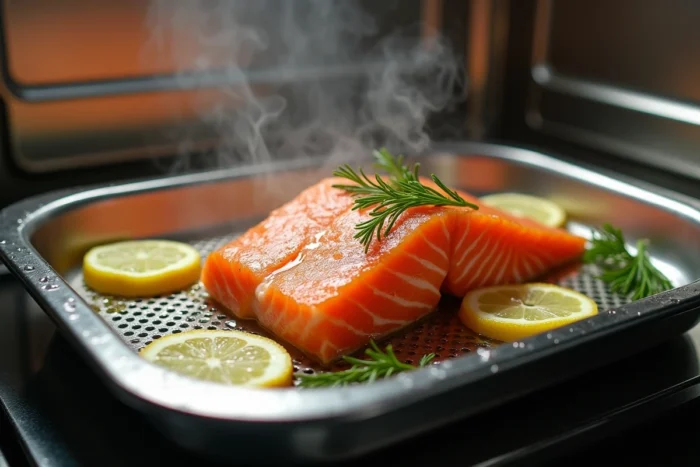
Removable tank or fixed connection: two steam cooking logics
A high-pressure steam oven directly connected to the water supply and drainage requires no manual addition. The supply is automatic, eliminating the risk of interrupting a cooking process to fill an empty tray. This is the main advantage of this type of installation.
Tank ovens, more common in domestic settings, require filling before the cycle. The capacity of the tank determines the available steam autonomy. During a long cooking process (braising, country bread), it may be necessary to top up along the way.
What changes concretely depending on the circuit
- Connected oven: no manual intervention, constant steam, but heavier installation (water supply, drainage, possibly osmosis system)
- Tank oven: flexible installation, but limited autonomy and user responsibility for water level and quality
- Compact combination oven with manual injection: hybrid between the two, often equipped with an optional connection and a backup tank
The choice between these configurations conditions the answer to the initial question. On a connected model, adding water manually is unnecessary and sometimes counterproductive (risk of excess humidity in the chamber).
Automatic steam injection functions: what recent ovens manage
Current generations of combination steam ovens feature automatic injection programs that dose the steam according to the set temperature and the selected cooking type. Electrolux, for example, offers several specific modes in its 800 series.
The SteamBake mode injects a burst of steam at the beginning of the cycle to promote the rise of bread dough and the formation of a shiny crust. SteamCrisp combines convection heat and steam to achieve a crispy exterior and a fluffy interior. SteamPro offers continuous steam control across the entire temperature range.
These programs significantly reduce the need to add water by guesswork. The oven calculates the flow rate and duration of injection. Manually intervening in this case amounts to short-circuiting the cooking algorithm, with a risk of excess humidity that softens textures instead of enhancing them.
When manual addition remains relevant
On a classic oven (without integrated steam function), the technique of using a container of water or ice cubes on the tray remains valid for certain recipes. Home baking is the most common use case: a few ice cubes thrown onto the preheated drip tray produce a burst of steam in the first minutes of cooking.
This artisanal method works, but it has limitations:
- The steam produced is brief and unregulated, unlike a dedicated generator
- Opening the door to add water drops the temperature in the chamber
- The thermal shock on an enameled cast iron tray can, over time, cause micro-cracks

Maintenance of the steam circuit: frequency and warning signals
A poorly maintained steam oven produces less steam, distributes it unevenly, and eventually breaks down. The descaling of the generator or tank is the central operation. On a domestic tank appliance, we observe that a descaling cycle every fifteen to twenty uses maintains stable performance, depending on the local water hardness.
Signs that should alert you: an abnormally long steam rise time, visible whitish deposits in the tank or on the chamber walls, a metallic smell during preheating. Ignoring these signals accelerates the degradation of seals and injectors.
On models connected to the mains, replacing the osmosis system filters follows a schedule defined by the manufacturer. Failing to adhere to this schedule often voids coverage in the event of a breakdown related to scaling.
The question “should water be added” masks a more structural issue: the quality and regularity of maintenance of the steam circuit determine the success of cooking more than the amount of water poured. A tank full of hard water produces less effective steam than a tank half-filled with filtered water.