
The fashion trends for the autumn-winter 2026 season are built as much on the runways as on the behavioral data of millions of online users. The Pinterest Predicts 2026 report, which claims an accuracy rate of 88% over the last six years, identifies aesthetics like “Cool Blue” or “Neo Deco” well before they appear in mainstream guides. Understanding these signals allows for sustainable clothing choices rather than chasing every micro-trend.
Pinterest Predicts and Behavioral Data: Anticipating Fashion Trends Before the Runways
Fashion is no longer limited to catwalks. Visual platforms analyze the searches and pins of hundreds of millions of users to spot emerging aesthetic movements. The Pinterest Predicts 2026 report has identified 21 trends from this data, with verified reliability over several years.
Among the identified aesthetics, “Glitchy Glam” offers deliberately imperfect looks, counter to ultra-polished makeup and styling. “Gimme Gummy” focuses on materials with gel-like and tactile finishes, while “Neo Deco” reinterprets Art Deco in prints and accessories. These directions are already influencing autumn-winter collections without always being named in traditional magazines.
To follow these movements in real-time, checking the news on Mode For You allows you to spot pieces that concretely translate these aesthetics into accessible ready-to-wear.

European Regulation on Unsold Fashion: What Changes for the 2026 Collections
The European regulation (EU) 2024/1781 on eco-design introduced, since July 2026, a ban on the destruction of unsold textiles for large companies. This regulatory constraint directly alters how brands design their seasonal collections.
Brands are producing shorter and more targeted series. Fewer references per season means pieces designed to last several months in a wardrobe, not just the duration of a social media post. Neutral colors, reimagined classic cuts, and durable materials are gaining ground over ultra-trendy pieces with rapid obsolescence.
At the same time, France has been applying tariff penalties since September 2026 on ultra-fast fashion players. Brands that multiply low-priced references are taxed, increasing the cost of these disposable garments for the end consumer. Adapting one’s style to more durable pieces becomes both an economic and aesthetic reflex.
Key Colors and Materials for the Autumn-Winter Season
Frosted blue (“Cool Blue” according to Pinterest) emerges as the standout color. Unlike the usual navy blues of winter, this light and cool blue works well on both structured jackets and thick knit sweaters. It easily combines with off-white, gray, or burgundy.
Tactile materials replace smooth surfaces. The “Gimme Gummy” trend translates into ready-to-wear through textures that catch the eye and touch: soft leather, thick corduroy, looped knits. Pairing two contrasting textures in one outfit (for example, corduroy pants and a smooth knit top) is enough to create depth without piling on accessories.
- The frosted blue replaces classic blue and pairs with cool neutral tones for a modern winter look.
- Leather remains a safe bet, worn as a short jacket or midi skirt, with a marked preference for soft finishes over rigid ones.
- Art Deco prints (geometric lines, fan patterns) appear on dresses and scarves, directly stemming from the “Neo Deco” aesthetic.
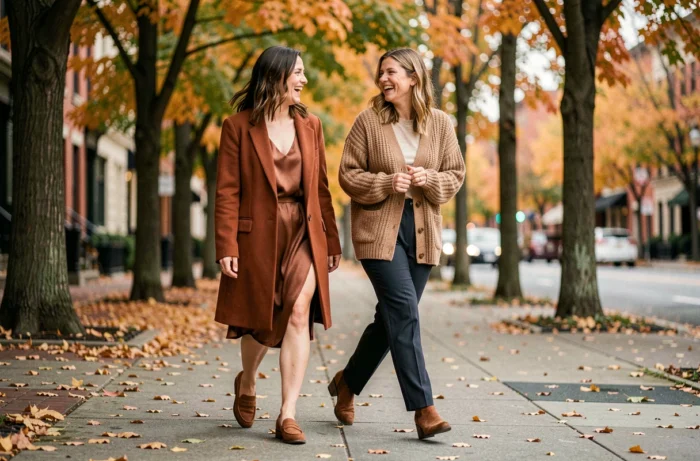
Style Tips According to Body Shape: Adapting Trends to Your Silhouette
Following a trend does not mean wearing the piece exactly as it appears on a model. Each trend comes in several cuts suited to different body shapes. The barrel jean, for example, suits elongated silhouettes but can shorten a smaller silhouette if the waist is not defined.
For A-shaped bodies (hips wider than shoulders), an oversized sweater tucked in at the front into high-waisted pants balances the silhouette while staying within current codes. V-shaped bodies (broad shoulders) benefit from choosing flowing dresses or flared skirts that draw the eye downward.
- H-shaped body: focus on fitted jackets and thin belts to define the waist without overly structuring.
- O-shaped body: favor fluid materials and straight cuts. Avoid bulky layers that add thickness.
- X-shaped body: most cuts work. The trap is piling on too many trendy pieces at once, which muddles the silhouette.
Digital Product Passport: A Tool for Better Choosing Your Pieces
The Digital Product Passport (DPP), provided for by the same European eco-design regulation, is starting to appear on some garments. This QR code integrated into the label gives access to the exact composition of the fabric, the country of manufacture, detailed care instructions, and sometimes the estimated carbon footprint of the piece.
The DPP transforms the act of purchasing into an informed decision. Knowing that a jacket contains a precise percentage of recycled fibers or that a pair of jeans was made in a certified workshop allows for objective comparison of two pieces beyond price and appearance. Mid-range European brands are gradually adopting this system, which will become mandatory for new product categories in the coming years.
The autumn-winter 2026 fashion trends are read through a dual filter: the aesthetic signals captured by data platforms, and the regulatory constraints pushing towards more thoughtful wardrobes. Choosing a piece in frosted blue, soft leather, or geometric print remains a matter of personal taste, but checking it via its digital passport before purchasing is becoming a growing reflex.