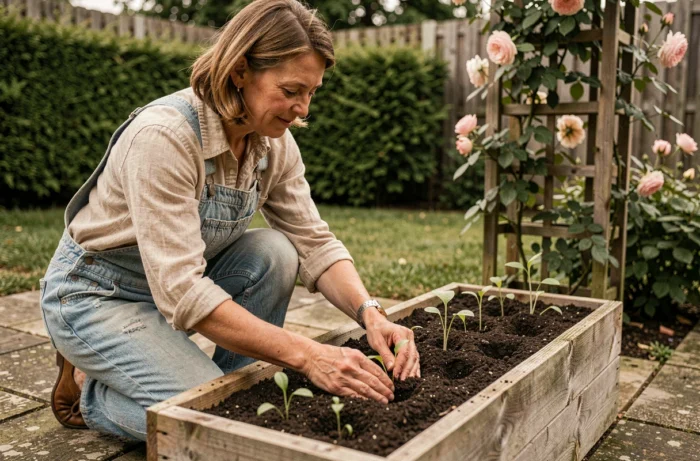
A well-functioning garden relies less on the accumulation of plants than on a few structural choices: the soil, exposure, plant palette, and materials. These choices, made in advance, determine both the appearance of the garden and its ability to withstand the seasons without requiring excessive maintenance.
Soil and permeability: the primary constraint that a welcoming garden imposes
Most landscaping guides start with style or a list of plants. The concrete starting point, however, is underfoot. The type of soil (clay, sandy, limestone, loamy) determines drainage, species selection, and the durability of hard landscaping.
Clay soil retains water in winter and cracks in summer. Planting a lavender bed in this context leads to quick losses. Conversely, well-draining sandy soil is suitable for Mediterranean plants but dries out hydrangeas in just a few days of heatwave.
The regulations related to the trajectory of zero net artificialization (ZAN), stemming from the Climate and Resilience Law of August 22, 2021, and later adjusted by the law of July 20, 2023, push to limit new impermeable surfaces. For a home garden, this concretely means favoring permeable coverings (stabilized gravel, cellular slabs, Japanese stepping stones laid on a sand bed) rather than concrete slabs poured over an entire terrace. This approach has a dual advantage: it meets local regulatory requirements of the ongoing PLU revisions and improves rainwater management on the plot.
The resources available on the site Nos Jardins & Vos Paysages detail various garden configurations that integrate these soil and permeability constraints into their landscaping proposals.
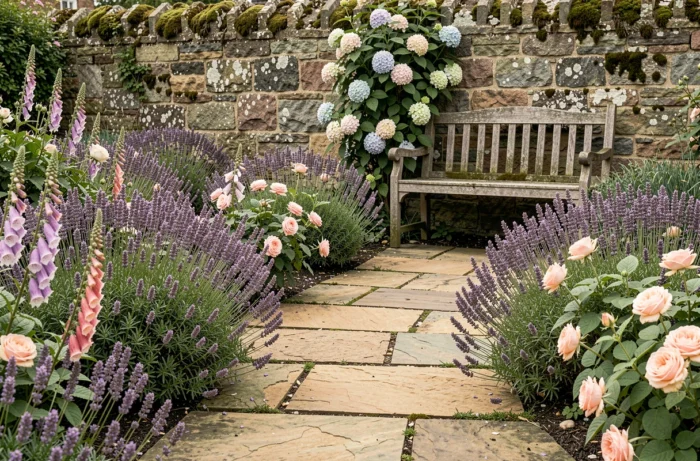
Plant palette and climate adaptation: choosing plants for the garden of tomorrow
According to a survey reported by Futura Sciences, six out of ten French people have already changed their gardening practices in response to climate change. This figure reflects a concrete shift in practices: amateur gardeners no longer just choose plants for their appearance; they incorporate drought resistance and heat tolerance into their criteria.
The concept of a robust garden facing extremes
The term “robust garden,” highlighted during the 2025 edition of the Folie des Plantes in Nantes, refers to a garden capable of withstanding strong climatic variations without permanent irrigation. The principle is based on three axes:
- Selecting deep-rooted plants capable of accessing water underground during dry periods (examples: gaura, perovskia, yarrow, grasses like stipa).
- Generously mulching beds with organic materials (wood chips, flax straw, dead leaves) to limit evaporation and nourish soil life.
- Grouping plants by water needs: water-demanding species near the house (easily irrigated area), drought-tolerant species at the back of the garden.
This organization by hydration zones avoids water waste and naturally creates different atmospheres in the garden, from the lushest to the driest.
The waterless garden, a radical approach
Libération dedicated a feature to the “waterless garden” at the end of August 2026, documenting projects where irrigation is eliminated after the installation phase. The principle works in regions with sufficiently rainy winters: plants, chosen for their extreme resilience, establish themselves over two winters with supplemental watering, then manage on their own. Field reports vary on this point depending on soil types and local microclimates, but the trend is gaining ground in southern France and is starting to interest gardens further north.
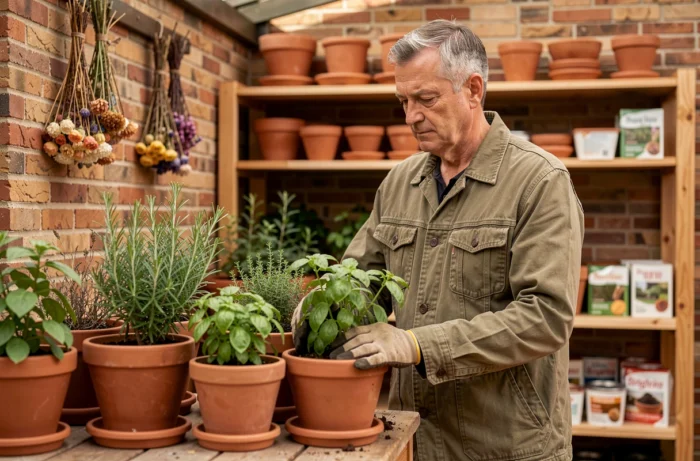
Materials and structure of the garden: wood, stone, metal
The harmony of a garden depends as much on materials as on plants. A dry stone wall, a corten steel border, a wooden terrace: each mineral or structural element sets the tone.
Limiting the palette of materials to two or three creates a coherence that accumulation does not allow. A garden that mixes exotic wood, exposed aggregate concrete, white gravel, painted steel, and bricks ends up looking like a catalog. It is better to choose a dominant material (wood, for example) and an accent material (local stone) and then stick to it.
Wood remains the most commonly used material for garden terraces. Treated European species class 4 (autoclaved treated pine, black locust, chestnut) offer an alternative to tropical woods whose sourcing raises documented environmental concerns. Black locust, in particular, has a natural durability comparable to teak without chemical treatment.
Outdoor lighting and evening ambiance: extending the welcoming garden after dark
A garden designed solely for daylight loses half of its usage potential between May and September, precisely the period when one wishes to enjoy it the most.
Effective outdoor lighting relies on distinct layers of light:
- Functional lighting for paths and steps (low bollards, recessed spots), directed towards the ground to avoid light pollution.
- Ambient lighting for living areas (string lights, lanterns, candles), which creates an atmosphere without glare.
- Accent lighting to highlight a tree, a living wall, or a fountain (directional spots with narrow beams).
Avoiding uniform lighting throughout the garden preserves contrasts between light and shadow areas, visually enlarging the space and respecting the nocturnal cycles of local wildlife.
Solar systems have become more reliable in recent years. For locations receiving at least four to five hours of direct sunlight, they now provide sufficient lighting without wiring, significantly simplifying installation in an existing garden.
A harmonious garden is not established in a weekend. The choices of soil, climate-appropriate plants, consistent materials, and layered lighting form a technical foundation that, once properly laid, then allows for the natural evolution of the garden season after season.