
Between major national brands and private label references, powder detergents hold a special place on supermarket shelves. Their formulation differs significantly from liquid detergents or capsules, with direct consequences on stain removal power, cost per wash, and environmental profile. This guide compares the criteria that distinguish a high-performing powder detergent from a mediocre one, focusing on what the composition and format truly reveal.
Powder, liquid, or capsules: how format affects performance
Most guides rank detergents by brand without explaining why powder format behaves differently in machines. Powder contains oxygen-based bleaching agents (sodium percarbonate, perborate) that activate at temperatures starting from 40 °C. These compounds are absent in liquid detergents, which explains the difference in results on white laundry and stubborn organic stains.
| Criteria | Powder Detergent | Liquid Detergent | Capsules |
|---|---|---|---|
| Bleaching Agents | Present (sodium percarbonate) | Absent | Varies by brand |
| Low-Temperature Efficiency | Limited below 40 °C | Good from 30 °C | Good from 30 °C |
| Residues on Dark Fabrics | Risk of white marks | Low | Low |
| Long-Term Storage | Stable if stored dry | Risk of separation | Sensitive to moisture |
| Average Cost per Wash | Generally the lowest | Intermediate | The highest |
Powder remains the most economical format for washing white laundry and durable textiles. However, it is not suitable for short cold cycles on delicate or dark fabrics, where a liquid detergent dissolves its surfactants better.
To delve deeper into these performance gaps between commercial references, the ranking of the best powder detergents on Votre Déco details the results product by product.
Composition of powder detergents: the ingredients that make a difference
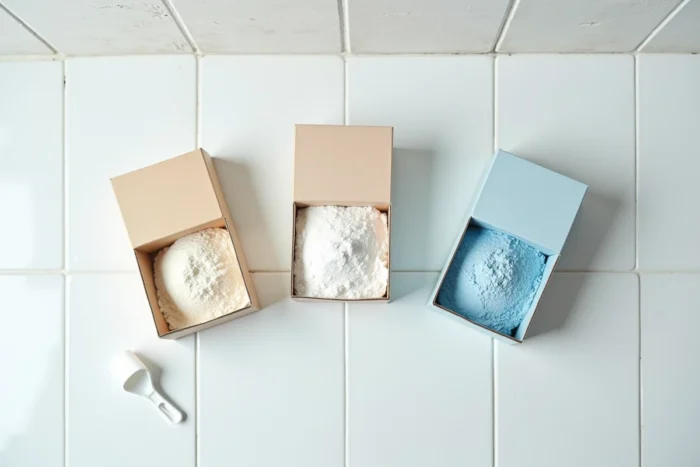
Two powder detergents that look similar on the shelf can have very different composition profiles. The first reflex is to check the INCI list or the detailed sheet on the manufacturer’s website. Three families of ingredients deserve special attention.
- Surfactants: they ensure the washing power. Anionic surfactants (sulfates) are the most common and effective on fats but can irritate sensitive skin. Non-ionic surfactants, often derived from sugar or coconut, are gentler.
- Synthetic fragrances and preservatives: often flagged by consumer associations as sources of contact allergens. Formulas labeled Ecocert or Ecolabel significantly limit their presence.
- Optical brighteners: these fluorescent molecules create the illusion of a brighter white but do not clean anything. They remain trapped in the fibers and can cause irritation on reactive skin.
A powder detergent displaying an Ecocert or European Ecolabel guarantees a minimum threshold of biodegradability for surfactants and the absence of certain controversial substances. This does not indicate anything about pure stain removal power, which mainly depends on the dosage of enzymes (proteases, amylases, lipases) and percarbonate.
European regulations on detergents: what changes for powder detergents
A rarely discussed angle in purchasing guides concerns the evolution of the European regulatory framework. The European Regulation 2026/405 on detergents and surfactants introduces new requirements that will modify the formulation and labeling of powder detergents in the coming years.
Among the new features, a digital product passport will allow access, via a QR code on the packaging, to detailed composition, biodegradability results, and environmental performance of each reference. For consumers, this means much greater transparency than current labels, which are often incomplete.
At the same time, the update of the CLP regulation (2024/2865) introduces new hazard classes for mixtures, including detergents. Substances classified as persistent, mobile, and toxic (PMT) or endocrine disruptors must now be included on the labeling, with an obligation to update within six months in case of more severe reclassification. Voluntary digital labeling (QR code) complements this system.
These developments will facilitate product comparisons directly on the shelf, provided the QR code is scanned. Brands that are already reformulating their powders to anticipate these obligations will have a readability advantage with informed consumers.
Selection criteria in supermarkets: quick reference guide
For white laundry and durable textiles
Prefer a powder containing sodium percarbonate and various enzymes (protease, amylase, lipase). The ideal cycle is between 40 °C and 60 °C to activate the bleaching agents. The powder outperforms liquid detergent on hot organic stains.
For sensitive skin and baby laundry
Look for Ecocert or Ecolabel mentions, check for the absence of synthetic fragrances and optical brighteners. Formulas labeled “sensitive skin” are not all equivalent: only the detailed composition allows for a decisive choice, not the packaging marketing.
For budget
The cost per wash varies from one to three times between a private label brand and a premium brand. Supermarkets regularly offer private label powders whose compositions rival national brands in surfactants and enzymes, at a significantly lower price.
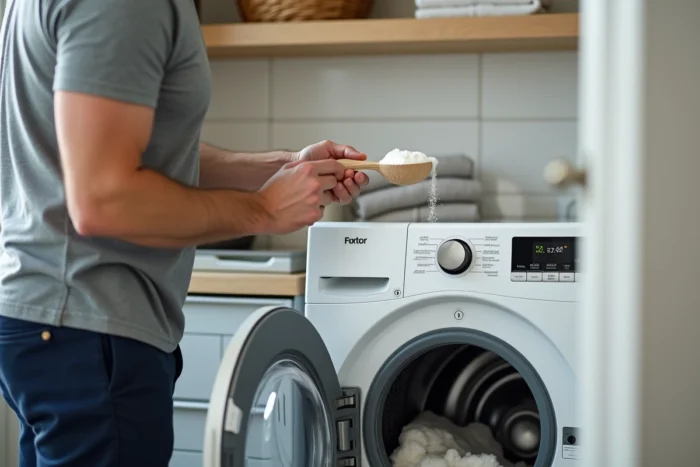
Ultimately, the choice of a powder detergent in supermarkets relies on three verifiable parameters: the presence of oxygen-based bleaching agents, the nature of the surfactants, and the allergenic profile (fragrances, brighteners). The arrival of the digital passport on detergent packaging will simplify this reading in the coming years, making the complete composition accessible with a scan.