
A protective grille installed on a window in a condominium simultaneously touches on two legal frameworks: the Construction Code (safety against falls) and the co-ownership law (respect for common areas and harmony of the facade). Before drilling any holes in an exterior wall, it is essential to untangle these two logics, as one may make the installation mandatory while the other may block it.
Guardrails, security grilles, mesh: three devices, three distinct functions
The confusion between these devices fuels most disputes in co-ownership. A window guardrail meets a regulatory obligation: Article R.134-59 of the Construction and Housing Code requires that, on upper floors, any window with its lower part located less than 0.90 m from the floor must be equipped with a support bar and a protective element reaching a minimum height of 1 m from the interior floor.
A security grille (metal bars) aims at anti-intrusion protection, especially on the ground floor or first floor. It is not mandatory under the Construction Code but may be required by a home insurance policy to maintain certain theft guarantees.
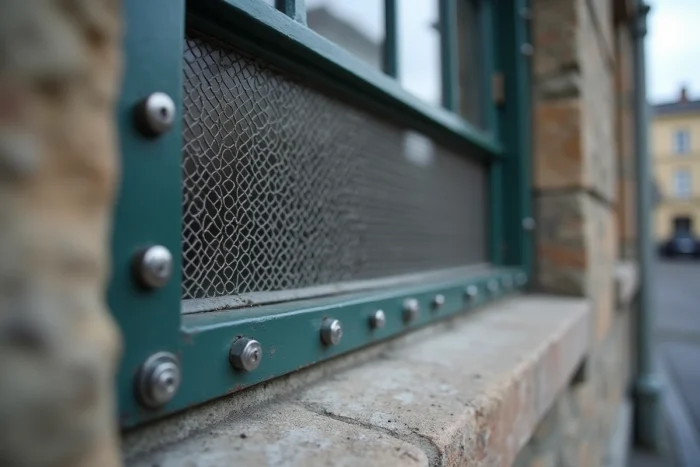
The protective window mesh, lighter in weight, often serves a mixed role: preventing the fall of a child or pet, deterring an intrusion, or protecting against pigeons. Its legal status in co-ownership directly depends on the claimed function and its visual impact on the facade. To delve deeper into co-ownership rules on Easy Home, the topic is addressed from the perspective of voting in the general assembly and best installation practices.

Voting in the general assembly: applicable majority and cases of exemption
Any modification to the exterior appearance of a condominium building requires prior authorization from the general assembly. The facade is a common area, even if the window itself may be considered a private lot according to the co-ownership regulations.
The vote is conducted by a majority as per Article 25 of the law of July 10, 1965 (majority of all co-owners, whether present or not). This rule applies because the installation of a grille affects the exterior appearance of the building. If the majority of Article 25 is not reached but the project receives at least one-third of the votes, a second vote by simple majority (Article 24) can be organized immediately.
When can the request be refused
The co-ownership syndicate can refuse the installation for several legitimate reasons:
- The chosen grille model disrupts the harmony of the facade (color, material, style incompatible with the existing structure)
- The co-ownership regulations explicitly prohibit devices added to external openings
- The installation encroaches on a common area (fixation in a load-bearing wall or a classified frame)
A co-owner who installs a grille without authorization is subject to a formal notice from the property manager, followed by legal action aimed at dismantling it at their expense.
Special case: safety obligation and young children
When a co-owner invokes the safety of a child and the window does not meet the minimum height protection requirement, the refusal of the general assembly can be challenged in court. The judge then weighs the impact on the harmony of the facade against the risk of falling. Case law tends to favor safety, provided that the proposed device remains discreet and reversible.
Co-ownership regulations and urban planning constraints: the double filter
Obtaining the green light from the general assembly is not always sufficient. The co-ownership regulations may impose specific requirements regarding authorized materials, colors, or types of fixation. Some older regulations prohibit any additions to facades without distinction.
In protected areas (perimeter of a historic monument, safeguarded sector, remarkable heritage site), authorization from the architect of the buildings of France (ABF) is required in addition to the co-ownership vote. The review period can take several months, and the refusal of the ABF takes precedence over the agreement of the co-ownership.
Outside of protected areas, the installation of a grille on a window generally does not require prior declaration to the town hall, as it does not modify the footprint or the floor area. Nevertheless, check the local urban planning plan, which may contain specific provisions regarding the appearance of facades.
Choosing the grille and installation in co-ownership: technical criteria to anticipate
The selected model must meet the desired function while respecting the constraints voted on in the assembly. Three criteria guide the choice:
- Mechanical resistance: a child-proof anti-fall grille must withstand significant pressure without deforming, which excludes thin flexible meshes
- Fixation method: installation by anchoring in the window frame (private part) poses fewer problems than sealing into the facade wall (common part)
- Reversibility: a removable system without visible traces facilitates obtaining the vote and avoids conflicts during the resale of the lot
The most common material remains galvanized or powder-coated steel, whose color can match existing joinery. Aluminum offers a lighter alternative, suitable for smaller windows.
Practically speaking, involving a professional ensures compliant installation and provides a useful certificate in case of a claim. A faulty installation that causes damage (falling debris onto public roads, injury to a third party) engages the responsibility of the co-owner and potentially that of the syndicate if the authorization was granted without technical verification.
The protective window grille in a condominium remains a seemingly simple piece of equipment, but legally framed at every stage. The starting point is always the same: read the co-ownership regulations, then add the question to the agenda of the next general assembly before ordering any materials.