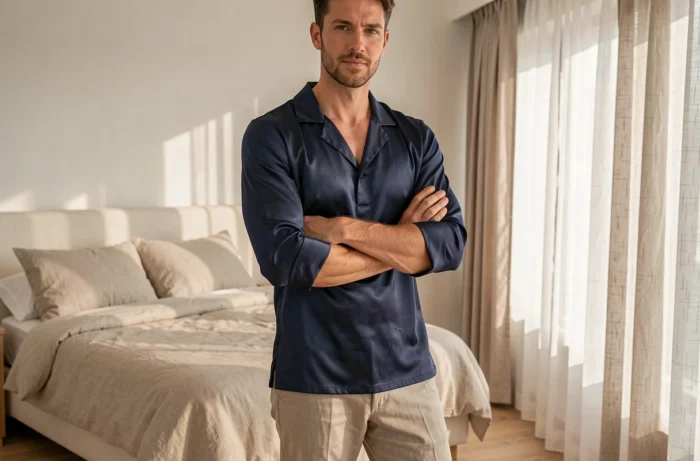
The nightgown for men exists in the catalogs of specialized French boutiques, listed between pajamas and bathrobes. It is no longer a curiosity on the runway or a topic of amused forums. Brands like Chemise Pyjama Paris now include satin nightshirts for men in their standard offerings, alongside boxers and briefs.
Fabrics and Cuts of the Men’s Nightgown: What Sets It Apart from Pajamas
Have you ever worn a loose t-shirt to sleep? The men’s nightgown starts from this gesture and takes it further. The cut generally falls to mid-thigh or the knee, with a wider armhole than a classic pajama top.
The difference lies in the fabric. Satin, viscose, and sometimes silk replace the usual jersey cotton. These fabrics glide over the skin instead of sticking. In summer, the feeling of coolness is immediate. In winter, a lined satin offers light insulation without the bulk of pajama pants.
Finishes vary by brand. Some offer open V-necks with contrasting piping, while others have straight models without buttons. The idea remains the same: a fluid nightwear piece, more breathable than a two-piece set, that allows the body to move freely during sleep.
Browsing the men’s nightgown from Mode Création, one notices that the models focus equally on nighttime comfort and a refined aesthetic, with details like fine lace or adjustable straps.
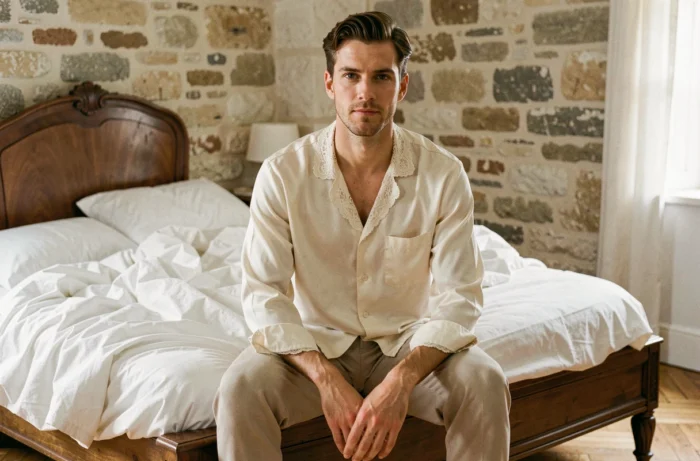
Men’s Lingerie and the End of Stereotypes: Why Fashion Codes Are Changing
For a long time, men’s lingerie was limited to three options: boxers, briefs, and trunks. Anything outside this trio was seen as eccentric. This rigidity is crumbling.
A report by Le Monde published in January 2026 documents men wearing traditionally feminine lingerie to break away from stereotypes. One explains that reciprocity felt natural to him: women have been wearing masculine cuts for decades, and the reverse movement simply took longer to normalize.
The men’s nightgown is not a disguise but a reimagined nightwear piece. The nuance matters. It is not about feminizing the male wardrobe, but about expanding the range of what is offered to men in terms of comfort and seduction.
The Role of Designers in This Evolution
Louis Gabriel Nouchi, established in the French fashion landscape since 2017, has helped make men’s lingerie visible on the runways. His pieces feature fitted cuts, fluid fabrics, and plays on transparency that did not exist in traditional men’s wardrobes.
In recent autumn-winter shows, satin nightgowns worn in broad daylight appeared at houses like Saint Laurent, Isabel Marant, and Gucci. These nighttime silhouettes are migrating into everyday wardrobes, and the boundary between intimate wear and visible clothing is becoming porous, for both women and men.
Satin or Viscose Men’s Nightgown: Choosing Based on Use
The choice of fabric determines almost everything: sensation on the skin, durability, maintenance. Here are the most common options in the current offerings.
- Polyester Satin: the most affordable. Smooth and shiny touch, dries quickly after washing. Can generate static electricity in dry weather, making it less pleasant in winter.
- Viscose (or Rayon): semi-synthetic fiber derived from cellulose. Excellent moisture absorption, fluid drape similar to silk. Requires delicate washing to avoid shrinking.
- Natural Silk: the most breathable and thermoregulating fabric, but also the most fragile and expensive. Reserved for occasional use or for those who accept meticulous care.
- Fine Cotton or Cotton Voile: a more understated option, without shine. Suitable for men looking for the comfort of a nightgown cut without the lingerie look.
For a first nightgown, viscose offers the best compromise. It provides a satin effect without the downsides of polyester, and its maintenance remains simple with a delicate cycle at 30 degrees.
Men’s Lingerie Trend: A Market in Structuring
The French e-commerce offering shows a concrete change. Specialized nightwear boutiques no longer hide men’s references in a secondary tab. At Chemise Pyjama Paris, the satin nightshirt for men is listed in the main “men” category, on the same level as classic pajamas.
This commercial normalization goes beyond societal discourse. When a product transitions from being a curiosity to a standard catalog reference, it indicates that demand exists and is recurring. The men’s nightgown has moved from the realm of provocation to that of functional nightwear.
What the Positioning of Brands Reveals
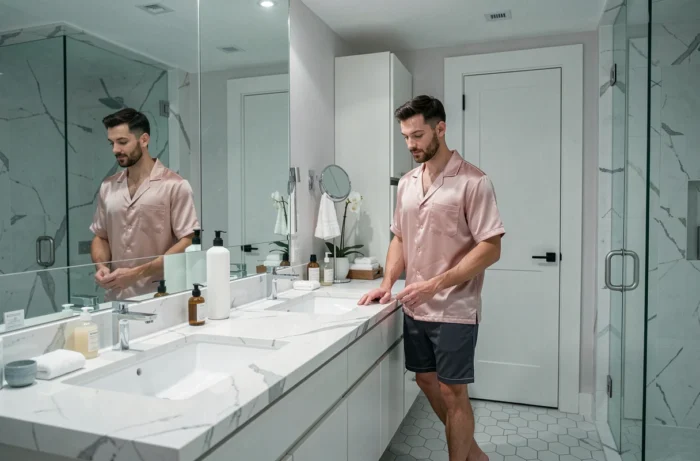
Brands that offer men’s nightgowns do not present them as militant products. They photograph them in ordinary domestic contexts: bedroom, living room, breakfast. The message is simple. It is nightwear, not a manifesto.
This pragmatic positioning facilitates purchase. A man hesitant to order a nightgown will feel more comfortable facing a product description that discusses thermal comfort and breathable fabric than one that argues about the deconstruction of gender.
The trend of men’s lingerie continues to diversify, driven both by fashion designers and online boutiques responding to real demand. The men’s nightgown will not replace classic pajamas for everyone, but it has found its place in the nightwear wardrobe, between boxers and bathrobes, as an option among others for those who prioritize comfort and lightness.