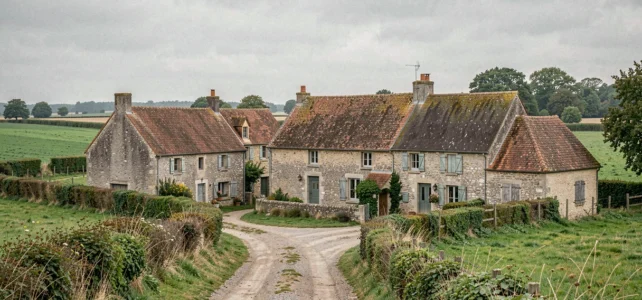
Hamlet, place-name, village: these three terms refer to distinct geographical realities, but their boundaries remain blurred for most residents as well as real estate professionals. Understanding what separates them requires crossing specific criteria: presence of buildings, administrative status, registration in the land registry, collective facilities. It is this intersection that this article aims to measure.
Cadastral place-name, inhabited hamlet, structured village: comparative table
| Criterion | Place-name | Hamlet | Village |
|---|---|---|---|
| Administrative status | Cadastral subdivision, not a municipality | No official status | Often the administrative center of a municipality or a full municipality |
| Presence of buildings | Not mandatory (can refer to a field, a wood, an intersection) | Small group of dwellings | Rural agglomeration with grouped dwellings |
| Collective facilities | None | None or very few | Parish church, town hall, sometimes shops |
| Cadastral registration | Yes, included in a cadastral section | Identified on the land registry, but without its own delineation | Center of the municipal land registry plan |
| Toponymic origin | Name attributed by local custom | Often linked to a farm or agricultural operation of origin | Derived from Latin villa, designating an agricultural estate |
This table highlights a fundamental gap: the place-name may not contain any dwellings, while the hamlet and the village always imply the presence of residents. The place-name is primarily a unit of geographical reference within the land registry.
The resource offering a definition and difference between hamlet and village reminds us that these notions vary by region, particularly in Charentes where the word “village” long referred to simple isolated agricultural operations.
Place-name in France: a cadastral reference that may disappear from addresses
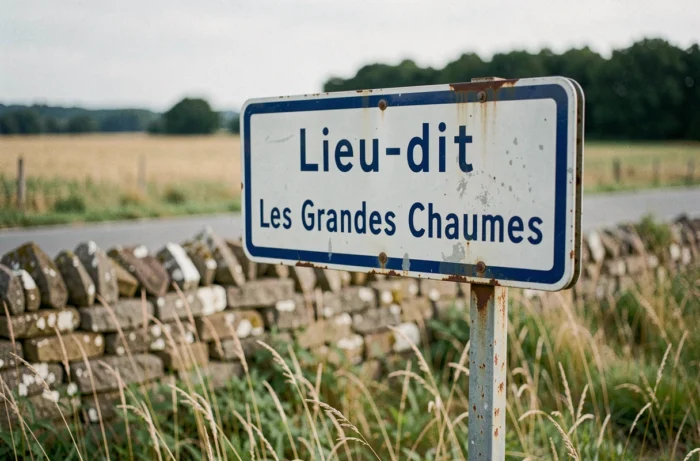
The place-name is defined by the land registry as a subdivision of the cadastral section corresponding to a sector named by local custom. Depending on the region, it may be called finage, mas, réage, or triage. Its boundaries are drawn on the cadastral map, and it is always fully included within the same section.
On the ground, a place-name can refer to a cultivated field, a wood, a hill, or an intersection. There is no requirement for it to contain any construction. This characteristic clearly distinguishes it from the hamlet.
Modern addressing threatens the visibility of the place-name
The current addressing standard, driven by the National Address Base (BAN) and Local Address Bases (BAL), prioritizes the triplet number, street, municipality. The 3DS law did not eliminate place-names, but it mandates the naming and numbering of streets.
In practice, each municipality decides whether or not to retain the place-name in the transmitted address. The place-name may then appear in a supplementary field, or disappear from new addresses, even if it remains locally known. This phenomenon creates situations where a resident receives an address like “12, Vignes Road” while the entire neighborhood continues to refer to it as “place-name Les Vignes.”
Digital mapping tools, such as those from HERE, still represent place-names in their data. They classify them as destination names for address searches, without granting them the status of a municipality or that of an administrative built zone.
Hamlet and village: what separates them beyond the number of houses
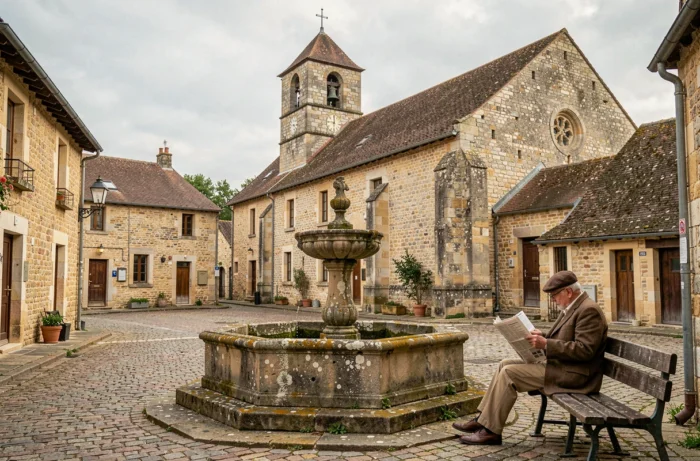
The Le Robert dictionary defines a hamlet as a “small group of houses away from a village” and a village as a “rural agglomeration, a group of dwellings large enough to have its own life.” The difference thus rests on two axes:
- The size of the built grouping: the hamlet has a few houses, the village gathers enough to constitute an autonomous entity
- The presence of structuring facilities: historically, the village had a parish church, while the town was distinguished by its authorized market
- The administrative attachment: the hamlet depends on a municipality whose administrative center is elsewhere, the village often corresponds to the center of the municipality
The founding element of the hamlet is often a farm. Wikipedia specifies that the term “hamlet” (or “écart”) refers to a group of dwellings in a rural area too small to be considered a village.
A boundary blurred by regional history
In Saintonge and Charentes, the classic distinction between hamlet and village does not hold. Jacques Duguet, cited by the Breuillet site, reminds us that the word “hamlet” was completely unknown in the region. The term “village” there designated groups of agricultural operations, sometimes reduced to a single dwelling, divided or not after inheritance shares.
This regional confusion is not anecdotal. It explains why some old land registries call “village” what, seen from Paris or Lyon, would resemble a hamlet of three farms.
Urban planning code: concepts without a numerical threshold
The urban planning code uses the terms “hamlet” and “village” without defining them by a number of inhabitants or constructions. This absence of a quantitative threshold poses a concrete problem for urban planning permits, particularly in mountain or coastal areas where buildability depends on the classification of the built zone.
A hamlet in urban planning terms does not grant the same construction rights as a village. Urbanization extensions are generally only allowed in continuity with an existing village, not an isolated hamlet. Administrative jurisprudence decides on a case-by-case basis, examining the density of buildings, the presence of facilities, and the continuity with the existing urban fabric.
This legal ambiguity means that two neighboring municipalities can classify a grouping of identical size differently, one seeing it as a hamlet, the other as a village. The classification chosen directly modifies the construction possibilities for landowners.
The most reliable criterion for distinguishing these three concepts remains their function: the place-name names a location, the hamlet houses a few households away, the village organizes collective life around shared facilities. When the administration hesitates, it is often because the land does not fit into any box, and local reality always precedes the legal category.